






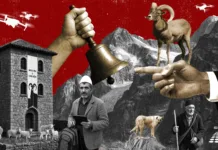



In the mountains of Labëria, the sound of bells and shepherds’ whistles that once accompanied every morning has now been replaced by the quiet of the wind blowing through empty pastures. Livestock, once the backbone of the agricultural economy, is dying out due to lack of state support, bureaucracy and the emigration of young people. Most small farmers are left out of subsidy schemes, which are often taken advantage of by big businesses, significantly increasing inequality in rural areas.
Official statistics from the last five years show that of the 2.43 billion lek allocated for livestock, agriculture and fishing, only a small portion has benefited farmers in the Vlora River. Meanwhile, the real costs of feeding livestock far exceed the aid, making the subsidies symbolic and unsustainable.
The number of livestock and households engaged in livestock farming has declined significantly over the past few decades, making the activity increasingly difficult for young people and the remaining families.
For its part, the Albanian government has announced an integrated support package for the agricultural sector.
The National Investment Scheme 2025 offers a fund of 20 million euros in grants, combined with a soft loan guaranteed by the state with an interest rate of only 2%. These government measures aim to increase the standards of livestock and agricultural production according to EU standards with the objective of exporting 1 billion euros of agricultural products by 2030. But despite the measures taken by the government, the reality in the villages of the Vlora River is very bleak and hopeless. The herds are dying out little by little every day, while the sheep are almost empty.
The Labëria without her flocks


In the village of Velçë i Lumit in Vlorë, Sako Xhaferaj, an old shepherd, is trying to keep alive a story that seems to be fading away every day. Of the 200 sheep he once had, only 80 are left now. Everyone else has left. They have sold their livestock and fled wherever they can.
“I had 200 sheep, now I only have 80 left. Everyone else has sold their livestock and left, because there is no life here anymore. We have not received any help from the state. They say I do not meet the conditions, but I have these opportunities,” says the shepherd.
According to information from the Directorate of Agriculture in Vlora, to benefit from subsidies, a farmer must have at least 10 heads of cows to receive 100 thousand old lek per head, 50 beehives to receive 10 thousand old lek per beehive, or over 100 heads of small cattle to receive 10 thousand old lek per head.
According to farmers in the area, most of them cannot reach the required number of heads due to economic difficulties.
“We, who have less, cannot join forces just to get some help,” says Sakoja, emphasizing that bureaucracies and rigid criteria have excluded any form of support from local bodies.
From what livestock farmers in the villages of the Vlora River such as Brataj, Gjorm, Lepenicë, Matogjin, Sevaster and Shkozë tell us, the number of livestock has decreased significantly over the past few decades.
Today, fewer than 7,000 head of cattle and about 18,000 sheep and goats remain — almost half the number the area had in 2010.
Data shows that in other villages such as Lapardha, Mavrovo and Kotë, the situation is equally dramatic, with herds dwindling every year and stables turning into ruins.

In Shkozë, Sevaster, Asim Bonaj, 68, remembers the times when every house had its own herd and when the fields were full of life.
“I have 50 heads. Even in 1944, during the war, we had 120 goats and 98 sheep. Then they handed them over to the cooperative. In this area, at the beginning of democracy, there were people and there were also cattle. But now they are gone. Of the 150 houses that used to exist, only about 50 remain, and even those are no longer called houses, because only the elderly live there. Those who keep cattle are very rare,” says Asim, according to whom the village is totally abandoned and desolate.
“Here we have no water. I myself don’t even have water to drink, let alone for the livestock. Everyone has dug wells to supply themselves with water. Even those who keep livestock have neither space nor conditions. There was more prosperity during the communist era than now,” adds Asim.
The former chairman of the Sevastar cooperative, Naim Selami, recounts how once the fertile land and organized cooperatives fed the entire community, while recently everything is being devastated day by day.
“Nothing else works. Only if the state invests, this area can be developed. I am convinced that they have taken the grants from AZHBR for themselves, I can assure you of this. We have not seen any help here, no benefits, no projects,” says Naim Selami, according to whom the only subsidy that the residents of the area receive is a few liters of diesel.
“They give us from 10 to 50 liters of diesel, and even that doesn’t work for anything. I have 1 hectare and 7 dunyams, and what will I do with the 30 thousand lek for two dunyams they give us? It doesn’t work for us at all,” says the agronomist.
Even in the village of Shkozë, residents face the same challenges for survival.
Andon Kasaj has been breeding sheep for over 20 years. The 53-year-old, together with his son, takes care of them day and night, while they barely see their welfare.
“I have 350 heads of cattle and I have been engaged in livestock farming for 20 years. I took them to Korça, because the fields here can no longer support them, the season comes and it dries up in 6 months. I keep them in pens, not in stables, and during the winter we buy food, because the state aid given is only for oil” – says the shepherd.
Çobenërit 2030

In July 2025, the Albanian government approved a special state loan guarantee scheme with a total value of 3 billion lek, which will be disbursed to the agricultural sector.
The aim of the scheme is to stimulate lending by commercial banks in the agricultural sector, where the state is the guarantor of 70% of the lending value.
This scheme, which provides soft loans, is integrated with the national investment scheme 2025 , with a fund of 20 million euros, creating a complete package for the development of farms and the improvement of production criteria according to EU standards.
To benefit from this scheme and to be integrated with the grant measures, farmers or livestock breeders must meet two main criteria: Not to have had any tax liabilities or outstanding loans. To be registered entities and equipped with the farmer’s NIPT certificate.
While the government’s scheme is designed to serve development, it risks leaving out small and traditional livestock farmers who operate informally, such as in the Vlora River.
In the villages of the Vlora River, “shteg.org” did not find a shepherd registered with the tax offices.
What you find there are shepherds who do everything they can to keep their flock in a land that is becoming deserted every day, but who above all do not have a document proving ownership over it.
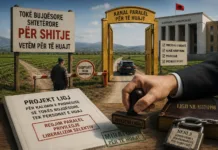
“We don’t have a land ownership certificate, because in Shkoza the update has never been done. Without a certificate, we can’t get the funds we need. Maybe if there was a fund or a staff to deal with this issue, the situation would be different,” say the remaining residents of the village with 75 houses, down from 270 a few years ago.
Not having a property document automatically excludes them from any support project or opportunity to benefit from grants.
“I’ve been involved in livestock farming for over 25 years, but I’ve never seen a situation like this,” says Viktor Naka, as he fixes the pen’s fences.
“Food prices have become unaffordable. Just for alfalfa and grass, it costs me over 150 thousand lek per month, not counting corn, soybeans and bran. The state gives us 10 thousand lek per year per head, but what do we do with them? They don’t even last a week’s worth of food. I have 300 sheep, but at this rate, next year I may have half of them left. It’s not just about the money, it’s about fatigue, lack of hope.”

The subsidies offered by the state to farmers are almost symbolic when compared to the real costs of keeping one head of livestock during the year. According to data from the Directorate of Agriculture in Vlora, to benefit from 10 thousand lek per year for each cow or 1 thousand lek for each sheep, farmers must have at least 10 heads of cows or over 100 heads of small livestock, a criterion that excludes most small-scale farmers.
Meanwhile, real food costs reach around 295 thousand lek per year for a cow and over 54 thousand lek for a sheep, which means that the subsidy covers only 2–3 percent of food needs.
The lack of real funding, hard work and above all the lack of hope has led to the daily decline of herds on the banks of the Vlora River.
“Once upon a time, the sound of bells could be heard here at dawn. Now you only hear the silence of abandonment,” says Sako Xhaferaj.
Note: “This publication has been made possible with the financial support of the Albanian Society of Civil Society. Its content is the responsibility of the author, the opinion expressed therein is not necessarily the opinion of the Albanian Society of Civil Society.”

Ai është gazetar me përvojë shumëvjeçare në median vizive dhe të shkruar, i specializuar në raportimin nga terreni dhe trajtimin e çështjeve sociale e komunitare. Ai është diplomuar në Gazetari–Komunikim dhe ka ndërtuar një karrierë të konsoliduar në disa televizione, duke u dalluar për qartësi, seriozitet dhe angazhim të pandërprerë në informimin e publikut.
Aktualisht, Armandi punon prej disa vitesh në Report TV, ku mbulon ngjarjet në qarkun e Vlorës dhe në zonat e Jugut të Shqipërisë, duke ofruar reportazhe të drejtpërdrejta dhe analiza të detajuara që reflektojnë realitetin e komuniteteve lokale.