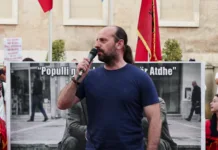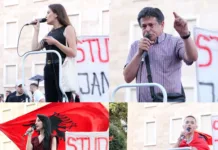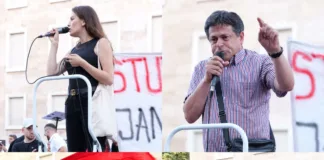
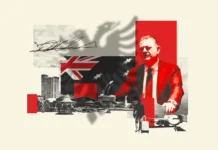

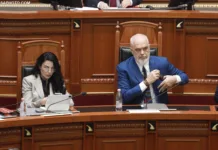
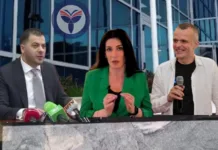
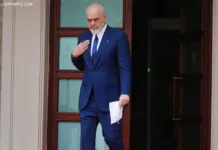
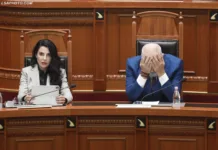
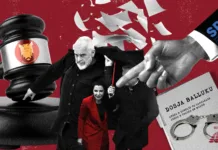
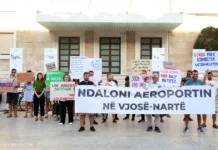

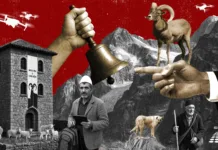
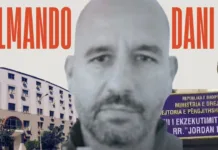
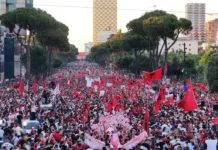
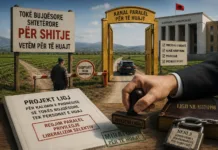
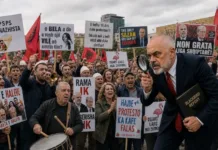
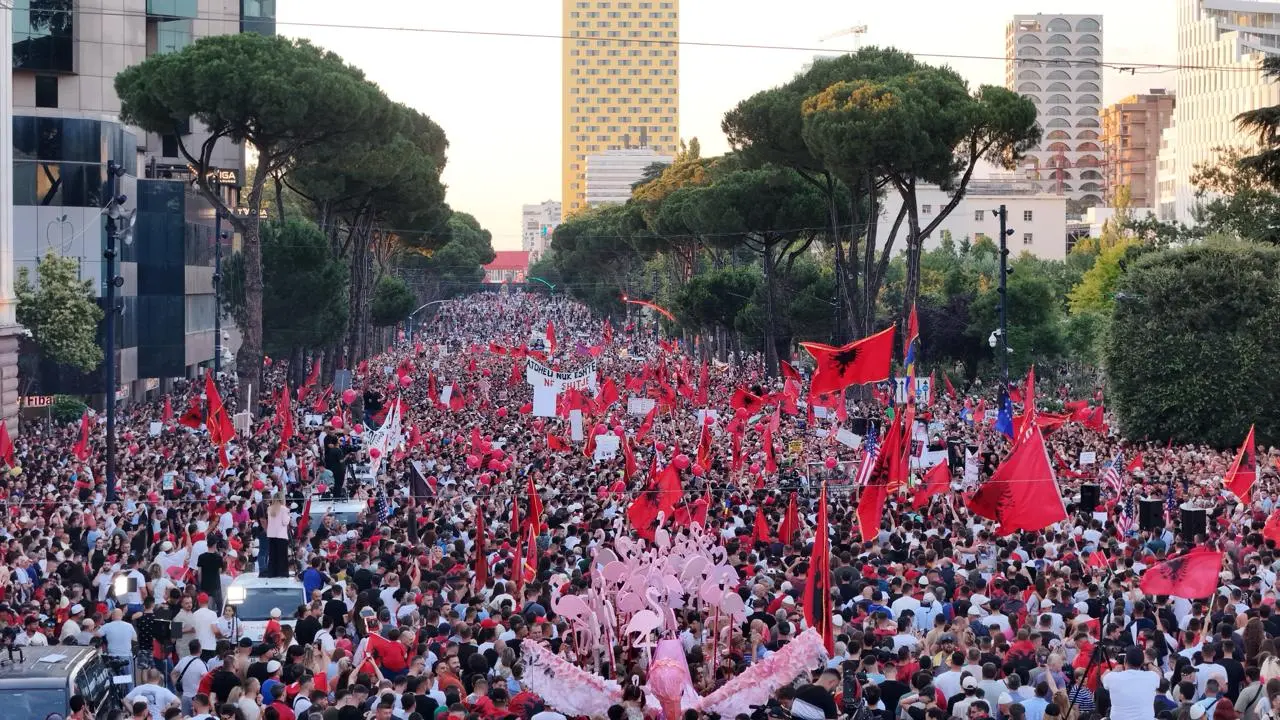
With memes, banners, charismatic videos and the rhythm of social media, the protest entered a terrain that, ironically, had been dominated by Edi Rama himself for years. Precisely where the prime minister had built a significant part of his political supremacy, a form of communication emerged that was not controlled by the government and did not obey the traditional logic of the confrontation between the majority and the opposition.
Initially, the government’s response appeared hesitant. But as the protest grew, so did the majority’s political narrative. Attention gradually shifted from the protesters’ demands to the protesters themselves. Instead of debating the essence of the cause, the focus shifted to the identity, motives, and past of those who represented it, calling into question not only the public figures of the protest, but also its legitimacy.
Almost every protester who takes the microphone ends up in the “scanner” of government communication. Photos, old posts, statements or episodes from the past are recirculated in search of an element that could undermine the individual’s credibility. Often, before the protest is over, the prime minister publishes videos and comments about certain participants on his social networks. Then, the same line of argument, the same labels and the same materials are reproduced by other deputies and figures of the Socialist Party, creating the impression of a coordinated and centralized communication.
For political communication experts, this is a classic narrative control strategy. The message does not remain at the level of the leader, but is distributed in a synchronized manner through political structures and social networks, with the aim of defining the framework through which the public interprets the event. In this sense, the battle is not only fought in the square, but also in the digital space, where perceptions are constructed, interpretations are challenged and, in the end, the political narrative is won or lost.
The need for the invisible “enemy”


As the protests entered their third week and showed no signs of abating, Edi Rama convened a closed-door meeting of the political leaders of the Socialist Party’s regions on June 20. What was discussed at that meeting was never made public. But in the days that followed, the change in the majority’s communication was evident.
The prime minister’s posts, videos, and statements began to be shared almost in real time by members of parliament and other figures in the Socialist Party. The same narrative, the same labels, and often the same wording were repeated simultaneously on dozens of profiles, creating the impression of a coordinated communication strategy rather than spontaneous individual reactions.
For journalist and academic Lutfi Dervishi, this is a typical mechanism of what is known in political communication as “message discipline.” According to him, the narrative is constructed at the center and then distributed in a synchronized manner by the entire political structure, with the aim of dominating the public debate and imposing a single framework of interpretation of events.
“If this synchronization is the result of internal coordination, then we are dealing with a classic strategy of message discipline. The party tries to ensure that the same interpretation of events is repeated by many voices simultaneously, with the aim of dominating the public debate,” explains Dervishi.
But this stance came after profound shifts in the government’s initial narrative. Initially, the protest was downplayed and treated as an episode that was expected to fade over the days. Then, as it continued to maintain participation and received international media coverage, the narrative began to change.
According to Political Science professor Klejd Këlliçi, this very phase marked the first turning point.
“The protest took on another dimension, finding the prime minister largely unprepared,” he explains.
According to him, in a party with centralized communication like the Socialist Party, MPs followed Rama’s stance even in silence. They maintained a withdrawn profile until the narrative began to consolidate.
“Since the Socialist Party has centralized communication and mostly MPs are withdrawn, many of them found themselves in the dilemma of reacting or waiting for a clarification of Rama’s position,” explains Këlliçi.
The initial communication of the majority relied mainly on generalizations. The protest was described as influenced by external factors, with repeated references to foreign agencies, Russian, Iranian or Greek interests. Bloggers and social media pages were placed at the center of harsh statements, mentioned without clear identity as examples of a wider manipulation campaign. When even these were not enough, the communication switched to specific names. From the protest as a phenomenon, the attention shifted to the individuals who took the floor in the square. Photographs, previous statements and episodes from their past became part of the public debate.
“In short, the ghost of Sali Berisha, as the main object of attack and the historical enemy on which the SP discourse is also produced, instinctively attracts special protesters,” argues Klejd Këlliçi.
The narrative no longer just required a common enemy. It also required concrete faces to embody it.
An incident, where a masked person tore down the Israeli flag, gave government rhetoric the opportunity to claim that the protest in the square was initiated by agents protecting Iranian interests.
A thesis not new to Albania, since the attribution of cyber attacks to Iran, which led official Tirana to sever diplomatic relations with this country.
This culminated in the non grata declaration, announced by the Minister of Internal Affairs, Besfort Lamallari, against a citizen, with the argument that her activity was considered a threat to the country, national security, as well as public order and safety. This is a person not unknown to public opinion, whose statements have caused a stir and dissatisfaction on the Internet, but long before he appeared as a protester in a photo taken in the square.
At least two other citizens have been published by Prime Minister Rama with the direct accusation that they are infiltrated persons, paid to protect Iranian interests.
For experts, the Prime Minister’s insistence on finding major causes in the ignition of this protest and shifting the narrative from generalizations to building a broader geopolitical framework would ease the ruling party’s own costs, seeking “ventilation” elsewhere.
“The flag incident was enough to characterize the protest as fueled by anti-Semitism. In recent days, a discourse is being built that presents the protest actors as pro-Iranian factors. This will also be the discourse of the majority and Rama: the idea of diverting attention from the protest’s demands to specific individuals,” says Professor Këlliçi.
These lines of communication with the public, in this case the protesters, are not unknown to political communication experts. But they should not deviate into manipulation through propaganda.
Professor Lutfi Dervishi argues that the line with propaganda is crossed when communication no longer aims to inform, but to manipulate.
“The border with propaganda is crossed when communication no longer aims to inform or argue, but to manipulate, through the distortion of facts, demonization of the opponent, systematic labeling, or the creation of a parallel reality,” he says.
Professor Clementin Mile also argues that it is not the coordination that necessarily makes a propaganda campaign, but the content and methods used. Labeling and shifting the focus to specific individuals bring about what experts call political “spin.”
“When there is a high synchronization of messages, repetition of the same labels and a shift of the debate from the issue to the person, then we enter the territory of political spin. The most obvious sign of this is when the discussion moves away from the questions raised by the protests and focuses on the delegitimization of the protesters or the figures who represent them,” he explains.
All for a narrative

Every day, before or after the protest, a protester, especially if he is one of its initiators, sees himself as a protagonist on the prime minister’s Facebook.
Within a short time, the same photographs, montages or lines of argument begin to be republished by other members of parliament and figures of the Socialist Party, multiplying the same message on different profiles.
For Professor Mile, the synchronized distribution on social media is indicative of a leadership crisis, which aims to keep under control the way the public is perceiving developments.
“This usually happens when the government realizes that the leader’s voice is no longer enough. It shows that the protest is no longer being treated as a local or temporary episode. The moment the reaction is distributed to the profiles of MPs, ministers and other political figures, the crisis has entered another phase. We are no longer just managing the problem, but managing public perception,” says Mile.
Professor Klejd Këlliçi says that centralized communication is not a novelty in the Socialist Party, but rather a method used, especially by some well-known MPs within the party. What is new for him is the involvement of some other figures, who have stayed away from this rhetoric for years.
“The SP has had and still has a centralized communication, which either reproduces Rama’s positions, or caricatures them to the extreme. It is not for nothing that the SP has chosen to speak through characters who seem to come from the Orange stage, using banality, personal attacks as part of the political repertoire. If previously this type of communication was used only by a few characters in the SP, now it is also being reproduced by silent individuals, but who have had a much more professional public profile,” he says.
According to him, this is not only related to communication strategy, but also to the internal dynamics of power. Political crises, he argues, also serve as tests to prove loyalty.
“The emergence of ‘evidence’ of the conspiracy was the turning point that mobilized the deputies around Rama, sensing an existential threat to the party and to himself. This type of crisis is also an opportunity, because, if overcome, the leader also identifies ‘internal enemies’.”
Këlliçi also links this mobilization to the departure of MP Koçeku from the Socialist Party. According to him, that moment created the perception of an internal betrayal and reinforced the conspiracy narrative, mobilizing some of the new MPs in defense of the leadership.
“The situation changed when MP Koçeku left the SP. This was the first turning point, when the segment of young MPs was mobilized, who felt it almost natural to label Koçeku’s betrayal,” the professor argues.
But, in this wave of innovations in the political arena, in a situation still evolving, the balance of losses and victories has not yet emerged.
But experts appear skeptical about how much this synchronization has served the Socialist Party this time.
According to Lutfi Dervishi, synchronizing messages can create the impression of unity within the Socialist Party’s electorate, but does not necessarily increase the credibility of the message to the wider public.
“Synchronization has a double effect. For party supporters it can give the impression of unity and determination, but for the wider public, especially those who are undecided, the repetition of the same message by many voices can create the perception of an orchestrated campaign,” he argues.
Klementin Mile also argues along the same lines.
“If communication takes the place of dialogue, it rarely succeeds in resolving the crisis itself,” says the professor.
Although the communication strategy has managed to mobilize some of the political structures, it remains doubtful whether it has managed to convince the public.
According to Klejd Këlliç’s analysis, the synchronization of reactions has brought a boomerang effect for the Socialist Party, causing long-term political costs.
“The government message has fallen. It is now only Rama and the party that are facing an irreversible crisis of confidence. If we look at the profiles of the MPs, critical, threatening, mocking and contemptuous messages dominate over supportive ones. The synchronization of reactions, especially when they use denigrating language, unfounded accusations or conspiracy narratives, is creating a deep division in the public, which, in the short and medium term, will be difficult to repair,” he emphasizes.
For more than a month, the government has tried to maintain control over the narrative, seeking explanations in conspiracies, external influences, the biographies of the protesters, or the loyalties of its political structures. While the protesters have continued to return every evening, raising concerns that touch every part of daily life.
The massive and consistent participation of every evening on the boulevard seems to constitute the citizens’ response to the government’s narrative, that they refuse to see developments through the lens of power. This is precisely what experts expect to be the greatest challenge of a government that, for more than a decade, has dominated not only politics, but also the way it is “narrated.”

Xhesika Tollia është gazetare në “Rrjetin e Raportimit të Krimit të Organizuar dhe Korrupsionit në Shqipëri” (RRKOKSH), ku fokusohet në investigimin dhe raportimin e çështjeve të ndjeshme që lidhen me korrupsionin dhe krimin e organizuar. Ajo ka përfunduar studimet Master në Shkenca Politike në Universitetin e Tiranës, duke i dhënë një bazë të fortë akademike njohurive të saj mbi institucionet, politikën dhe proceset ligjore në Shqipëri.
Gjatë karrierës së saj, Xhesika ka zhvilluar eksperiencë të rëndësishme pranë RTSH-së, ku është përfshirë në përgatitjen dhe realizimin e projekteve mediatike, duke ndihmuar në prodhimin e përmbajtjeve të thelluara dhe informuese për publikun. Ajo është e njohur për qasjen e saj të kujdesshme dhe analitike ndaj lajmeve, duke kombinuar investigimin me raportimin objektiv dhe të detajuar.