








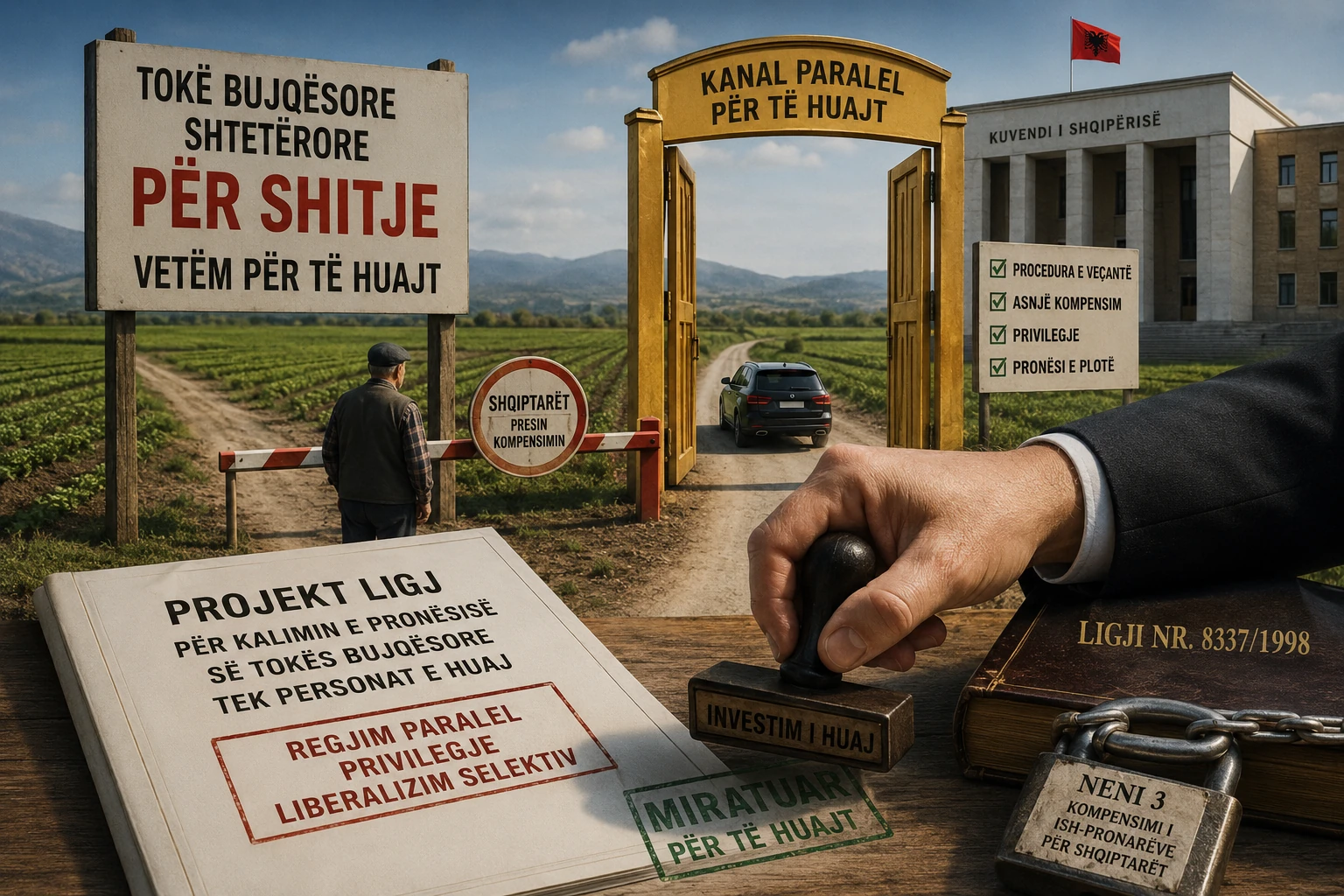
A draft law on the sale of state-owned agricultural land to foreigners is under consideration in the Government, and soon in the Parliament. The problem is not the idea itself, but the way it is constructed: a special law that creates a parallel regime, privileges foreigners over locals, and enables the privatization of land, which it sells as “foreign investment.”
Albania has built over the years a well-known model of law-making (I am not listing examples, because there are plenty of such and this is not the topic). When it wants to achieve a result that the existing law does not allow or allows, but with unpopular restrictions, the existing law is not changed. A new parallel law is created. It repeals only those provisions of the old law that hinder, preserves those that give it the appearance of protection and creates a new regime with the appearance of regulation, but with the effect of selective liberalization. The draft law on the transfer of ownership of agricultural land to foreign persons is a classic example of this model and the next, however not among the most sophisticated.
The simple test that reveals everything is this: if the true purpose of this draft law was to not discriminate against foreigners, as Article 1 claims, the minimal and correct legal solution would be a single article: repealing Article 4 of Law No. 8337/1998, “On the sale and purchase of agricultural land…” (existing and in force), which excludes foreigners from the general regime, and leaving them to be treated the same as Albanian citizens, with the same restrictions, the same procedures and the same rights. That’s it. One article. One page. Not twelve articles, not a special law, not a parallel regime.
The fact that the opposite path was chosen reveals the agenda. The special law only for foreigners is not an instrument of non-discrimination; it is an instrument of special treatment. And special treatment, according to Article 18 of the Constitution, requires objective and proportional justification. This law does not offer any such justification, because there is none. The asymmetry created is clear: Article 3 of Law No. 8337/1998, which links the purchase of state-owned agricultural land to the completion of the compensation process for former owners, remains in force for Albanians. For foreigners, the draft opens a new parallel channel. Albanians wait for their turn for compensation. Foreigners do not wait.
This asymmetry is not a technical drafting defect, but is the intended result. But there is also a more fundamental problem that the draft tries to mask with a name. What the law calls “transfer of ownership” is, legally and substantially, privatization of state-owned agricultural land. The land is state-owned, it passes from the state to a private entity, by notarial deed, against a price, forever. Article 3 of Law No. 8337 prohibited precisely this, not by chance, but because the process of compensating the former owners had not been completed and the state-owned land remained exposed to their claims. The new draft does not solve this fundamental legal problem: it neither completes the compensation, nor does it address the claims of the former owners. It simply creates a side channel that bypasses Article 3 for a category of buyers. Privatization avoided by the regular procedure, renamed as “foreign investment.”
To give all this the appearance of a prudent law, Articles 5, 6 and 7 impose a whole raft of conditions and obligations. Pre-purchase preconditions become problematic when they fall after the acquisition of ownership. Exclusive agricultural use, non-change of destination, documented real activity and, above all, revocation of ownership as a sanction for non-compliance. The law can restrict the use of property, but it cannot reclaim the property from the buyer without a clear procedure, strong reasons, proportionality and compensation. The draft uses the term “revocation of ownership”, but does not explain how it is done, who decides on it, or what happens to the money paid. This is not a legal guarantee, but an ambiguous provision that can easily be overturned in court. Fully acquired ownership cannot be restricted after transfer through unilateral legal obligations, without compensation. This contradicts Article 41 of the Constitution and Protocol No. 1 to the ECHR. Every legal expert understands that the restriction on non-alienation and revocation exist only to throw ash in the eyes of public opinion, to say: “Look, we put guarantees in place,” while the foreign investor knows full well that these will not withstand a judicial challenge.
The comparison table with European law closes the issue. No EU member state has created a special law that gives foreigners more rights over state land than locals. This draft has no European precedent, not only that, but also no Balkan precedent, and not because it is innovative, but because it is illogical as an instrument of legal policy.
What remains after the analysis is not a portrait of incompetent lawmaking. Real incompetence produces chaotic, directionless laws. This law has a very clear direction. It avoids the privatization procedure, bypasses compensation restrictions, privileges the foreign buyer, and covers everything with investment rhetoric. Dilettantiism is the facade. The purpose is the substance.

Irena Dule është avokate dhe eksperte ligjore e angazhuar në mbrojtjen e të drejtave të qytetarëve, interesit publik dhe shtetit të së drejtës.
Me një eksperiencë të gjatë në çështje administrative, mjedisore dhe të të drejtave të konsumatorëve, ajo ka bashkëpunuar për vite me radhë me organizata të shoqërisë civile, veçanërisht me Qendrën Res Publica, duke përfaqësuar qytetarë dhe grupe interesi në procese gjyqësore kundër institucioneve publike.
Dule njihet për angazhimin e saj në kauza që lidhen me transparencën, llogaridhënien dhe mbrojtjen e interesit publik në Shqipëri.
Po ashtu, ajo ka qenë pjesë e ekipit ligjor që kundërshtoi në gjykatë planifikimin urban të Bashkisë së Tiranës, në një çështje ku gjykata konstatoi shkelje procedurale dhe tejkalim kompetencash nga autoritetet vendore.