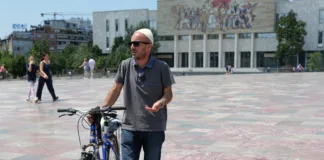


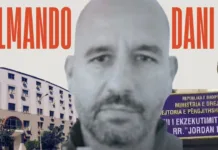
I will start by getting to know Tani. During the Kosovo war, sometime in March 1999, I happened to meet Sabit (Geci), who, beyond his name as a fellow countryman and fellow soldier of Adem Jashari, also had the reputation of a tough man, whom some of those close to the LDK were very afraid of, perhaps rightly so.
Sabiti was on crutches, as he had been injured. I thought he would be accompanied by several people, but in fact there was only one young man with him, small in stature and thin. He was the Dritan of today. At that moment I did not recognize him, but I understood that he was from Albania.
A few days later, I was talking to the late Rramush Tahiri, former Deputy Prime Minister of Kosovo, who reminded me that Dritani was the young military pilot who, together with the other pilot, the late Sallaku, had transported us to the Military Hospital in Tirana (where the current President, Bajram Begaj, was the deputy director), when the French journalist was injured. The square where the helicopter would land had been secured and guaranteed, with a Kalashnikov in hand, by the late Fatmir Haklaj, together with Feriz Kernaja.
Later I was informed and found out that Tani, the military pilot, was the son of one of our teachers at the military school, Dilaver Goxhaj, who had gone to Kosovo and become deputy to the Chief of Staff, Bislim Zyrapi. Several other officers had also gone with him.
Dritani, after leaving military aviation and joining the KLA, had taken with him three young officers, his friends and military pilots. Age takes its toll; they were young and the war had brought patriotic adrenaline to the maximum wherever there were Albanians.

The war ends and the interim government is established in Pristina. Azem Syla, the commander-in-chief of the KLA, becomes the Minister of Defense of the Interim Government with Prime Minister Hashim Thaçi. Daja (Azemi), the minister from Drenica, had taken as advisors two military men from Albania, Dilaver Goxhaj and Spiro Butka, who had been in the KLA.
For this reason, Dilaver’s small family, his wife, also a soldier, and sister Rezi, an IT student, settled in Pristina. I meet up with Dritan and some of his KLA comrades from Kosovo and Albania a few times, for casual political conversations, but nothing more.
The war begins in Presevo. I was working for the ANSA agency in Kosovo and my boss was Carlo Bollino, who told me that we should, no, go and do a report on the UÇPMB war.
I contacted someone who told me that I knew two of the commanders well: Tan Goxhaj and Agron Haradinaj. Well, I said, how can this guy be beaten, they’ll kill him there, he’s just a guy.
Anyway, we set off with Carlo, crossing the border, where American soldiers were yelling: “Where are you going, who are you?”, etc., etc….
Somewhere, a UÇPMB unit stopped us. It was Dritan Zheqi, Tan Goxhaj’s friend, who was a little further away, along with Agron, who recognized me and waved: let them go, since they knew me well.
Rightly, Dritani was angry with Albania at that time, as the Albanian government, with Meta as prime minister and Hajdaraga as minister, had expelled Albanian officers from the army because they had abandoned the army and joined the KLA.
The war in Presevo ended and the interim government in Kosovo had withdrawn; it was now the UNMIK government and the Goxhaj family had returned to Tirana, to their house on Bardhyl Street, unemployed former soldiers.
Dritani was living in Pristina and one fine day he returns to Tirana. News comes out that the Tirana police have arrested a terrorist from Kosovo.
Bollino and Çani tell me in the newsroom: “You and Artan Hoxha go, because you know Kosovo, and Tani the Tropoja police.” What do I see in the Tirana Directorate: the “terrorist” was Tani.
Sokol Bizhga had stopped him, because the “letters” had been sent to him by Sokol Bare, former deputy director of SHISH at the time, also a former police officer.
I, who knew the intrigues of Kosovo, said: he must have been involved in some internal post-KLA conflict in Kosovo (because there were many at that time) and they must have made some intrigue.
The police manipulated the Tirana media and, the next day, Tani was in prison and a dangerous “terrorist”, at that time linked to Al-Qaeda, because Iran was not fashionable. Our police had even called the officers of the American embassy to show them the “terrorist” trophy; they saw it, recognized it, laughed and left, saying that this could be related to anything, but not to terrorism.
I meet his father, Dilaver, for a coffee; upset, he tells me: “These Berishas persecute us as if we were Serbs, because we are from the South. And you socialists,” he tells me, “persecute us because we are lepers, because you are connected to the Greeks.” Helbete, the mayor was Fatos Nano and the prime minister was someone from the Southern Highlands, like Dilaver who was from Golem in Gjirokastra, Ilir Meta from the top of Cepan in Skrapar.
Well, a year later, Tani, who had been arrested with great fanfare, was released without any fanfare; all charges had been dropped and, as they would have it, they condemned him for having deserted the army as an aviation officer and having joined the KLA.
Naturally upset, in 2002, he and his family moved to Pristina, where some former comrades helped them financially with housing and work, and they survived. Rezarta finished her studies in Pristina.
In 2005, when the Socialists had gone into opposition, the Goxhaj family had returned to Tirana. Now, with them, as an ascetic with few pretensions, he ate bread once a day, went out rarely with very few friends, and one of the people he took the most time to go out was me; he stayed with me when I had time.
He says to me: “Can you help me because we are all unemployed, my sister graduated with honors in engineering and they won’t hire me?”
I take it and go to Lulzim Basha’s office and tell him whose daughter Rezarta from Gjirokastra was. And Luli tells me that we need young, prepared people, especially since she is Dilaver’s daughter.
Lulzim Basha, at the time Minister of Infrastructure, had come from Kosovo.
“I know,” he told me, “that they are from the South, socialist families, but they are patriots.”
Now, with the DP in power, the poor also became socialists.
Two years later, I go to my sister, Rezi,’s wedding, and I also meet Dritan’s mother, who says to me: “Oh Ilir, I still have a few years left until retirement and I’m a military chemical engineer. I heard that they’re still looking for chemists in the army; since you’re the National Security Advisor, can you tell General Lad Qiriazi?”
I told the general and he gladly took her to work, especially since he knew the lady. Now, with two people working and a little settled, the family was better off. Life was modest on the outskirts of Tirana, but like any family of ex-soldiers, they managed.
A year later, Dritani tries to emigrate to the Netherlands for about a year; with four foreign languages and experience, he might be able to manage. It didn’t last long, because luck doesn’t favor them. Dilaver, the father, gets sick and needs four bypasses. The only son returns to stay with his family and parents.
Meanwhile, with my troubles and my work, I had started a family and we saw each other very rarely, but I would go to the hospital. I remember going, I think, with the current prefect, the former prosecutor at the time, my friend Shkelqim Hajdari.
I see Dilaver, it was bad. We had a coffee with Dritan, who told me: “I have nothing to do now, I can’t go anywhere, I have to stay because my parents are getting old.”
I tried to find him a job at Casa Italia as a security officer, where he continued for a while and then left. He worked for a while as head of security at Casa Italia and then Denion Ndrenika, the Orthodox journalist, Dritan’s friend from Kosovo, took him to work at Civil Aviation Security.
Dritani, with his difficult character, did not sign some not at all transparent procedures of the senior director; this time the SMI decided to remove him. The lists had been made by Elona Guri, an important secretary in the party, since the directorate belonged to the SMI; they had decided to remove him.
I go to Elona Guri and say: “You intend to remove the most ascetic and incorruptible man, how are you not ashamed?”
“No,” Elona tells me, “they told me they are a socialist family, they should find them a job.”
I told him: “They lied to you, he’s just an unfortunate man, a well-educated pilot, a patriot and a scoundrel.”
Well, it didn’t change. A little later, the patronage team thought of bringing him out with the LSI and firing him.
Meanwhile, he had met a teacher and got married. He called me one day and said, “I have to tell you that I became a father to a son.”
I went and congratulated him with pleasure. I asked him: “What did you do for work?”
He tells me: “No problem, my wife is a teacher herself, I do some translations, we have rented a house, we don’t have money to hire a nanny; my mom helps me a little, I take care of raising my son.”
I honestly enjoyed it.
I met him when Hashimi was arrested with Rexhep Jakupi and others; he was very upset.
He says to me: “Shame, what is this whole thing?”
I, as an opportunist, say: “Mind your own business.”
“No,” he tells me, “you need to tell the President and others to take strong positions.”
I see him requesting documents, writing, giving interviews against the prosecution and the court, and on the day Sali Mustafa, Dritan’s friend, is sentenced, he attacks some of the court’s false witnesses from Albania and Kosovo by name and surname.
I call him and say: “Oh Tan, don’t bother with that, because the Special Court in Kosovo and here is taking you and putting you in prison.”
And so it happened.
One hot summer day, three years ago, my friend, Prof. Ermir Gjinishi, calls me and says: “They took the commander to prison.”
“Who did you get?” I say. “Tanin?”
I go to meet my elderly parents, who are very upset, my wife with her young child, and friends from Kosovo and Macedonia who were calling me.
What should I do? I go to Erion Veliaj’s office, because his mother, a soldier, had worked with Dritan’s father at the “Skënderbej” Academy.
Erion calls Ulsi, the Minister of Justice.
“I have nothing to do,” says Ulsiu, “The Hague is above me.”
I go to court; six people from the Hague Tribunal and one from the American embassy had come to extradite him to The Hague, because he had given the names of the witnesses, not that I knew either, but I just couldn’t stand it.
Thank goodness the Court of Appeals didn’t extradite him, otherwise he would still be in prison.

During these times, I’ve seen him “competing” with me in television studios as a military analyst, because the truth is that he works hard and is quite prepared; sometimes he succeeds and sometimes he doesn’t, but, in the end, like all of us who go out to the television booths and receive some honorarium.
I see that he had become a TikTok hero some time ago; what had he not said to Fredi Beleri? He had even told him that “you are an agent of SHISH”.
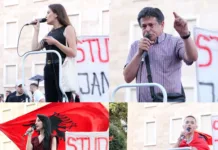
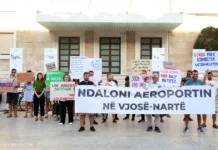
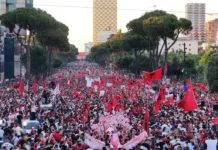
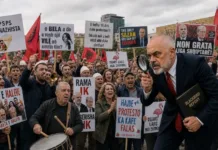
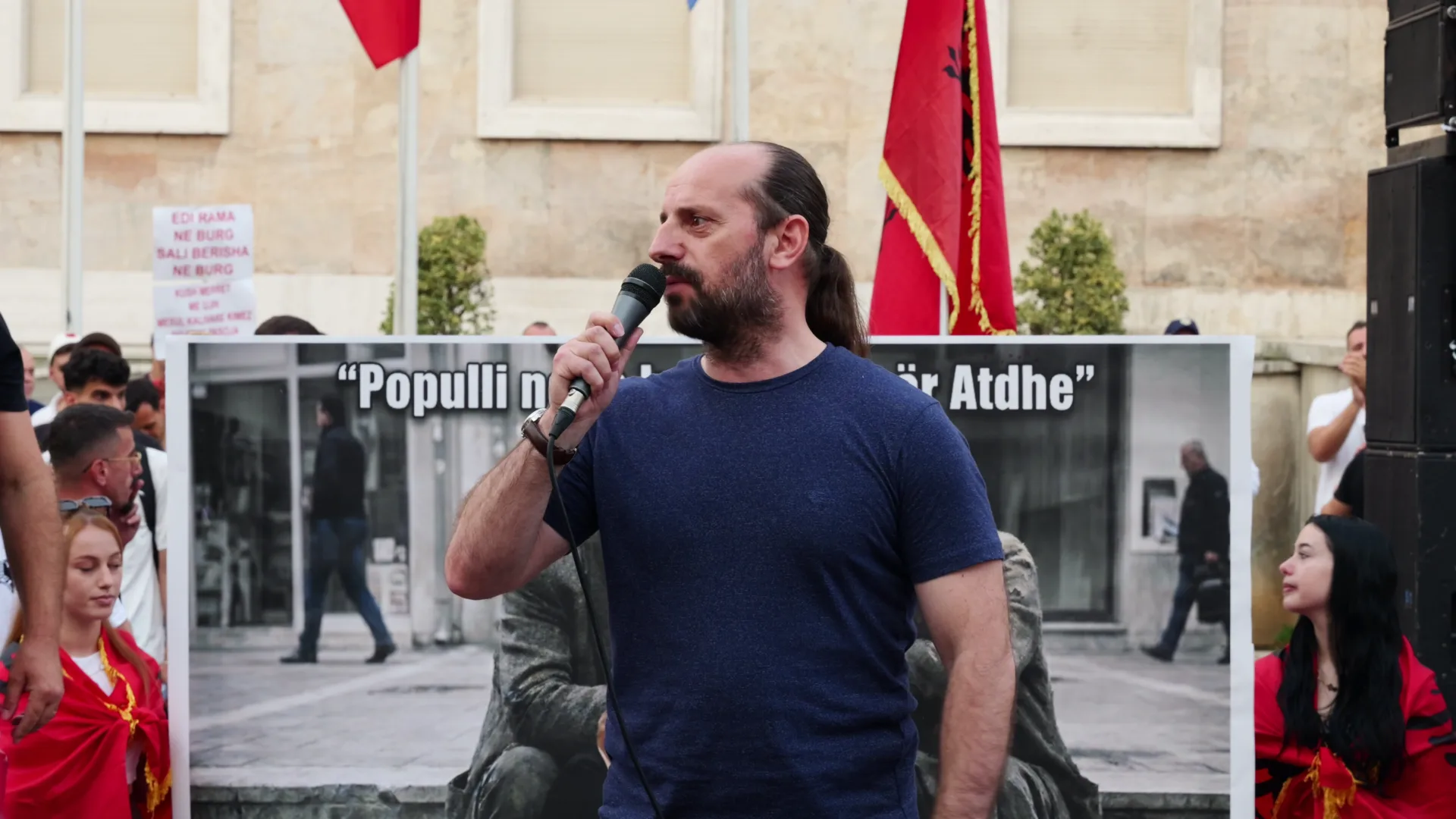
Last night, as I was returning from Kosovo, a friend sent me on WhatsApp the protest demands with the voice and image of Dritan. When I arrived in Tirana, I saw the response from Taulant, my old socialist friend, who described him as an agent of Iran.
In fact, Dritan’s life lacked this.
That Israeli agents had told him once 15 years ago, when he was accompanying an Israeli military friend of mine, Nir Shaul. The only thing he missed was Iran. But well, understandable; in this mess that has been created, everything finds a place and everything can be said.
Now I have a rhetorical question. Which of you, if you had a life like Dritan’s, educated abroad, with four foreign languages and with so many troubles, would you be protesting today or not?!
As for me, I know his mind well. He is not afraid of any kind of power, any kind of threat, gangs and thugs, of any kind and for any amount of money they want.
There is no billionaire who can threaten him, because he is the type of person who does not like money and luxury; like the ascetic that he is, he goes and lives alone in the mountains.
So, by putting one more “charge” on it, you don’t weaken it, you only strengthen it.
People like Dritani get along with good, because they can never get along with evil, because they are not intellectual opportunists, like me.