
















For more than three years, the Albanian courts, led by the Supreme Court, have held hostage the judicial investigation process regarding the construction of the Vlora airport.
In addition to a project built in the Vjosa-Nartë protected area, raising serious environmental concerns, the courts are also playing “procedural ping-pong”, without yet considering the merits of the case.
The court case related to the invalidity of the administrative contract for the construction of the Vlora International Airport, the repeal of Environmental Declaration No. 55/2021 and decision No. 04/2021 of the KKT, has been in a continuous cycle of procedural reviews for years, without yet being brought to trial on the merits.
Since environmental organizations, in March 2023, sued governing institutions over legal violations found in the procedures that paved the way for the construction of the airport, the process continues to be delayed due to procedural maneuvers by the courts.
Finally, after over two years of waiting, the Supreme Court finally revealed the decision it made in March 2023, with which it returned the process to zero, decided to return the case for retrial in the Appeals Court, a decision that, according to experts, simply prolongs the process, which until now has focused only on the legitimacy of the parties, the deadline for the lawsuit and not on the judicial investigation into the merits of the case.
Court Ping-Pong

On November 25, 2022, the Center for Conservation and Protection of the Natural Environment and the Ornithological Society of Albania filed a lawsuit against the concession contract and permits for the construction of Vlora International Airport.
With a file filled with over 100 pages and 1,400 supporting documents, the plaintiffs argued that the airport violated the law on the protection of protected areas and endangered the Vjosa-Narta protected area. For the plaintiffs, it was more than a legal battle, it was an effort to protect one of the country’s most precious ecosystems.
The plaintiffs argue that the airport violates the law on the protection of protected areas, endangering the flora and fauna of the Narta lagoon, and that the permitting process had serious procedural shortcomings. They emphasize that the associations are legitimate to file this lawsuit as they protect the public interest and have the right to challenge the responsible institutions, including the Ministry of Infrastructure and Energy, the Ministry of Environment, the National Environmental Agency and the National Council of Territories.
On the other hand, state institutions and the State Attorney’s Office argue that the associations do not have legitimacy to sue for normative acts, that the damage must be proven in a concrete manner, and that the contract for the construction of the airport was approved by a decision of the Council of Ministers. The Supreme Court, although it has recognized the legitimacy of the plaintiffs, has rejected the requests to stop the construction and operation, allowing the works to continue.
In a session that lasted only seven minutes, the Tirana Court dismissed the lawsuit on December 2, 2022, arguing that the plaintiffs lacked legitimacy and that the lawsuit was filed out of time. The decision was considered by the plaintiffs as the first obstacle in a long and complicated legal path.
The decision was appealed by the environmentalists. On 22 June 2023, the Administrative Court of Appeal overturned the First Instance decision, identifying procedural violations and ordering a retrial by a new panel of judges. The defendants filed an appeal with the Supreme Court on 23 October 2023, seeking the reinstatement of the First Instance decision.
After hearings in February and March 2024, the Supreme Court referred the case back to the Court of Appeal.
Although the legitimacy of the parties had been previously addressed in the context of decisions on securing the lawsuit, the Supreme Court, with decision no. 00-2024-5494, overturned the decision of the Administrative Court of Appeal and remanded the case for reconsideration, reopening the discussion on issues that were considered consolidated.
Procedural maneuvers

Meanwhile, requests to halt the airport’s construction and operations were rejected, allowing the concessionaire to proceed as if no legal obstacle existed.
In its decision, the Supreme Court posed additional questions to the Appeal, which, according to experts, further delayed the consideration of the case.
The Supreme Court’s decision was made public in April 2025, a year after the March 2024 hearing, only after complaints filed by environmentalists for violation of constitutional deadlines, arguing violation of the right to a fair trial and non-compliance with international standards for environmental protection.
The Supreme Court found that the Court of Appeal had not properly explained certain aspects of the procedure. It asked the Court of Appeal to correct these procedural deficiencies, while the examination of the substance of the case itself has not yet begun.
This sudden and unreasonable intervention by the Supreme Court delayed the legal process for the airport’s legality for over two more years.
However, the decision to elaborate on additional questions is considered unnecessary and has prolonged the process. Furthermore, the Supreme Court’s decision was only made public in April 2025, a year after the March 2024 hearing, following appeals by the parties on constitutional procedural issues.
Regarding the delays, the chronology of the case clearly shows that the Supreme Court’s delays were not merely technical, but functional. The March 2024 decision, by which the court returned the case for retrial to the Court of Appeal, opening unnecessary discussions on the legitimacy of the plaintiffs, remained unresolved for more than a year, blocking the process and keeping the file practically out of any substantive trial.
But as soon as the plaintiffs filed the request for injunction, a request that had to be reviewed by the court that had the file in hand, the metadata of the judicial system shows that the Supreme Court reasoned and clarified the decision and forwarded the file to the Court of Appeals within 24 hours. So, the file that did not move for more than a year was “released” within a day just to avoid reviewing the request for injunction. This documented fact refutes any idea that the delay was accidental. The court has used delays and procedures as control mechanisms over the time and pace of the process, postponing the real trial of the merits for years.
“The Vlora Airport case is the clearest example of how environmental justice can be blocked through procrastination. Instead of paving the way for the investigation of a matter of extraordinary public importance, the Supreme Court has shown a lack of will to let the case face the substance of the dispute. It has spiraled into completely unnecessary and even unprecedented procedural problems, delaying the process without any justifiable legal reason.
One of the most significant examples of this legal absurdity is the request that the Court of Appeals re-investigate the legitimacy of the plaintiffs, while the Supreme Court itself has legitimized the same plaintiffs earlier, when it examined the request for the suspension of the construction of the airport in the protected area. This is just one of several contradictory justifications that clearly show that the decision-making did not aim to resolve the case, but to postpone it. A justification that, in fact, has kept the case from trial for at least two years and, at the pace that this court has demonstrated, is expected to keep it frozen for a long time or even years, before the file is returned to where it belongs, to the trial of first instance and is finally investigated on the merits. Meanwhile, we are left discussing the same formalities, ‘e lagu, se lagu’, avoidable procedures that only delay justice.
Instead of guaranteeing an effective trial and within a reasonable timeframe, the court created a procedural ping-pong that in practice has sabotaged judicial control over the legality of projects in protected areas. The process has not been helped, it has been hindered. And this hindrance has real consequences for the environment, for public rights and for the very trust in justice,” says Av. Irena Dule, from the Res Publica center.
The case was returned to the Court of Appeal to determine the legitimacy of the parties and the procedures to be followed.
Three years later

In early November 2025, the Court re-examined the Vlora Airport case, also taking into account the issues left as a task by the Supreme Court.
During the last hearing, the plaintiff argued that the construction of the airport violates international laws and conventions for the protection of protected areas and that the risk to the flora and fauna of the Narta lagoon is immediate and irreversible. The defendant, represented by the Ministry of Environment, the Ministry of Infrastructure and Energy and the State Attorney’s Office, objected, saying that the associations do not have the legitimacy to sue for normative acts and that the damage must be proven with concrete documents.
After two long debate sessions, the Administrative Court of Appeal decided for the second time that the case should be examined on the merits, where the trial should have started three years ago, in the Administrative Court of First Instance of Tirana. With this decision, the issue of the legitimacy of the plaintiffs and the deadline for the lawsuit was finally exhausted. The arguments of the plaintiff, presented in a clear and detailed manner, were assessed as sound by the panel of judges, which decided that the process should continue on the content of the claim, without being hindered by procedural technicalities.
However, the “ball” is expected to return to the Supreme Court, which had previously returned the file to the Appeals Court on procedural questions, delaying the examination of the merits of the case. The same court also rejects the suspension of the construction and operation of the airport, as separate requests of the plaintiffs.
In connection with the court case regarding the invalidity of the administrative contract and the repeal of the acts that paved the way for the construction of the Vlora International Airport, “shteg.org” has officially addressed the Supreme Court for comment on a series of procedural developments that have accompanied the handling of the lawsuit.
In its request for the right to information, “shteg.org” raised questions about the necessity of returning the case to the Administrative Court of Appeal to reassess the legitimacy of the parties, despite the fact that this issue had been addressed earlier in the decisions on securing the lawsuit, as well as the risk that these decisions would lead to a postponement of the consideration of the case on the merits.
“Shteg.org” has also requested clarification on the delay of over a year in disclosing the Supreme Court’s decision, the impact of possible procedural maneuvers by the defendants and the third party, as well as on the practices of repeated referral of the case between judicial levels.
As of the publication of this article, the Supreme Court has not responded to a request for comment.
On the other hand, experts warn that this “procedural ping-pong game” could continue, trapping citizens and environmental organizations in a bureaucratic maze and allowing the concessionaire to advance with the project as if justice did not exist.
The Vlora Airport project was initially presented as an electoral promise by Prime Minister Edi Rama during the campaign six years ago. Shortly after, the Albanian government signed a construction contract worth 104 million euros, signed a few days before the parliamentary elections in April, a move that the opposition called in violation of the electoral law.
The project was won by an international consortium consisting of: YDA Construction (Turkey), with close ties to Erdogan’s party (AKP), Mabetex Group, owned by Kosovar businessman Behgjet Pacolli, and 2A Group sh.pk, owned by Valon Ademi, former Honorary Consul of Albania in Kosovo.
A British company disqualified from the tender has filed a civil lawsuit and a criminal complaint with SPAK, accusing the government of manipulating the tender and fictitious introduction of a company to give the impression of competition. It is also alleged that documents were fabricated.
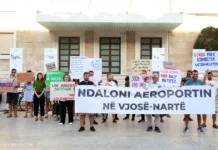
The project has encountered strong resistance from environmentalists and organizations, who say the airport is located near the Vjosa-Narta Lagoon, one of the most important ecological areas in the Mediterranean.
The wetlands are home to over 200 species of birds, including the Dalmatian pelican and flamingos.
To pave the way for the project, authorities dubiously changed maps of protected areas, removing legal protection for 26.7% of Albania’s coastal ecosystem. The National Territorial Council, led by Rama, approved the changes.
The construction of the Vlora airport has been opposed by the European Commission, the European Parliament, and the Standing Committee of the Bern Convention. The Commission’s 2021–2024 reports state that the project severely damages the environment and violates international conventions on nature protection. In September 2023, the Bern Convention called for the immediate suspension of the works, a recommendation confirmed in December 2023 and 2024.
Note: This publication has been made possible with the financial support of the GreenAL project, implemented by Co-PLAN, COSV and VIS Albania. The views and conclusions contained herein do not necessarily reflect those of the Swedish Government or Sida, the Swedish International Development Cooperation Agency (Sida).

Vjolanda Peca është diplomuar në Gazetari dhe Komunikim në Universitetin e Tiranës. Ka përvojë në gazetari investiguese dhe prodhim multimedial, duke punuar në Emisionin “Vetting” në News24 dhe në Faktoje.al, ku ka zhvilluar aftësi në hulumtim, verifikim faktesh, intervista në terren dhe prodhim përmbajtjesh për publikim online. Fokusi i saj është krijimi i përmbajtjeve informative që angazhojnë audiencën dhe ofrojnë informacion të thelluar.