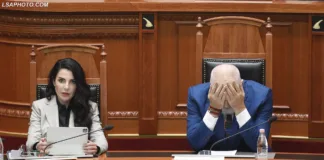
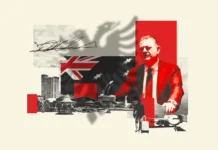

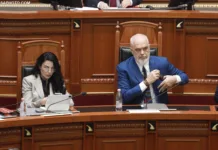
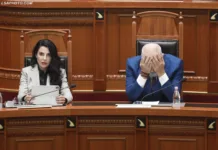


The marathon meeting of the Mandates Council, which took place today to review SPAK’s request to lift the immunity of Deputy Prime Minister Belinda Balluku, ended without any decision. After five hours of discussions, the council decided to postpone the decision-making for a second, indefinite moment, arguing the need for time to familiarize themselves with the evidence included in a file of over 10,000 pages.
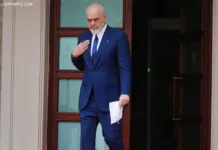
While the Balluku issue was expected to be discussed in the Parliament offices, Prime Minister Rama held the next meeting of the Council of Ministers. The media reported that Balluku climbed the steps of the Prime Minister’s Office for a meeting that apparently lasted about two hours, at the end of which the Prime Minister was seen leaving his office.
There has been no official announcement from the government on the Balluku case, but information has leaked today, both on the reaction of the special prosecutor’s office on which the restrictive measures against the deputy prime minister are based, and also parts of the file, which is said to be over 10,000 pages long.
Failed meeting of mandated persons

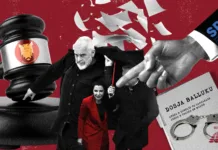
Around 10,000 pages of the Prosecution Office were used as a tool to prevent the deputies of the socialist majority from making a decision in the Mandates Council, regarding Deputy Prime Minister Belinda Balluku. The voluminous file, over 10,000 pages, contained materials that the Prosecution Office had submitted to the members of the Council, arguing the reasons why SPAK was seeking stricter coercive measures against Balluku, who had been under investigation since November 2025.
These documents became the subject of lengthy debates among the 10-member Council, with the opposition demanding full access to them from the beginning of the meeting. Balluk’s lawyer also requested the materials, choosing not to attend the Immunity Council meeting where the authorization for her client’s arrest was discussed.
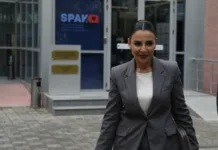
Shortly before the arrival of the new head of SPAK, Klodian Braho, and the two prosecutors investigating Balluku, Balluku addressed the Prime Minister’s Office for a government meeting.
After heated debates between the parties, the Council decided to distribute the materials of the file to the deputies and lawyer Ardian Kalija, starting a long discussion on the time needed to familiarize themselves with them. According to the prosecutors, three to five days were sufficient for the members of the Council, while the position requested that the meeting be held at the beginning of next week.
“It has never happened that the Mandates Council has closed without setting another date. The time has always been a minimum of 48 hours, a maximum of 72 hours. With the deadlines they have set, this issue is due to be reviewed in February; by February, Balluku has eaten baklava, evidence and witnesses. This is unprecedented,” declared the member of the Democratic Party in the Council, Gazment Bardhi.
The opposition insisted that the next meeting be called on Monday or Tuesday, while the SP proposed January 20 as the date for the next session.
After four and a half hours of debate and a 20-minute break, the head of the Immunity Council, Niko Peleshi, closed the meeting without setting a new date.
While the Mandates Council was debating the deadline for reviewing the Special Prosecution’s request for the arrest of Balluk, information began to leak to the media, both about the prosecutor’s implementation of the case submitted to the Assembly, as well as pages from the voluminous 10,000-page file.
In its report to the Parliament, SPAK argues that Deputy Prime Minister Belinda Balluku poses a real risk to the investigation, to evidence and to the public interest, describing her as “a personality who, due to the concrete circumstances and the function she exercises, may commit serious crimes or crimes of the same type.”
The investigation against Balluk has initially begun for two issues, for the procedures followed in the construction of the Llogara Tunnel worth around 190 million euros and Lot 4 of the Tirana Grand Ring Road.
But, according to documents leaked to the media, the investigation has expanded significantly and now includes almost all investments in the Grand Ring Road, as well as the PPP concession procedure for the Thumanë-Kashar axis, with an estimated value of around 245 million euros.
In the document, the prosecution specifically lists several procurement procedures, including the segments “Sheshi Shqiponja – Lumi i Tiranës”, “Sheshi Shqiponja – Bulevardi i Ri”, lots 5, 6 and 7 of the Outer Ring Road, as well as the PPP procedure “Thumanë–Fushë Krujë–Vorë–Kashar”. The beneficiaries of these procedures, according to SPAK, are various construction companies, for which it is suspected that unfair advantages and privileges have been created, in violation of the law on public procurement and the law on conflict of interest.
In its report to the Parliament, SPAK explains that Balluk is under investigation for the construction of the Llogara Tunnel, seven lots of the Grand Ring Road in Tirana, as well as three other tenders, including the Thumanë-Kashar concession.
Threats and tenders

In the report signed by prosecutor Dritan Prençi, Deputy Prime Minister Belinda Balluku is described as “a personality who could commit serious crimes”, underlining that the risk is real for the investigation, for evidence and for the public interest.
At least this is confirmed by materials leaked to the media, where prosecutors have established the intimidation of witnesses in the case for which Belinda Balluku is under investigation.
According to the prosecution, these attempts were detected even after Balluku was officially informed of the charges against her.
“From the use of special methods, data have emerged that the defendant Belinda Balluku … exerted pressure in various forms on the person questioned in these proceedings, specifically citizen MK, her subordinate,” the file states, according to which MK was a member of the Bid Evaluation Committee in the Llogara Tunnel tender.
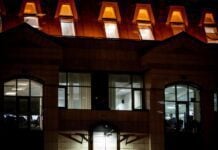
The prosecutor also notes that some of the documents needed for the investigation are located at the Ministry of Infrastructure and Energy, which continues to be headed by Balluku.
Part of the documents needed for the investigation “are found in various institutions, the main documentation is located at the Central Institution headed by this citizen herself, the Ministry of Infrastructure and Energy, various witnesses are being questioned, such as officials, subordinates of this defendant, etc.” – the report states, where it is argued that Balluku, while still in office, continues to manage public funds for infrastructure investments, which creates the possibility of repeating the same criminal offenses.
“Especially considering that several procurement procedures are being investigated and that the defendant continues to manage public funds for other public investments,” the document states.
In the same material, SPAK announces that the investigation will continue to expand and will not be limited to Belinda Balluku.
In the report submitted to the deputies, the prosecution emphasizes that Balluku is suspected of having manipulated at least 11 public tenders and of having exerted pressure on one of her subordinates, even after she had been indicted and had not yet been suspended from duty.
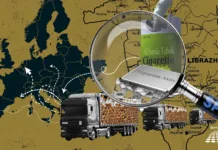
SPAK has identified 11 suspicious tenders, including the Llogara tender worth 190 million euros, the 7 lots of the Grand Ring Road (450 million euros), the Thumanë-Kashar concession (245 million euros), the Porto Romano-Durrës road (12 million euros) and the maintenance of the northern axes (440 thousand euros). According to the prosecution, Balluku, in collaboration with heads of contracting authorities, influenced the orientation of procurement procedures in favor of the winning operators, creating unfair advantages and actions contrary to the law.
In agreement with Rama

The 10,000-page dossier documents circulating in the media not only talk about how Balluku controlled the tender process, but also about the favors she provided to government clients. Some messages exchanged with her subordinates allude to the fact that some of the tender winners were predetermined by the prime minister.
From the conversations on “WhatsApp” it appears that the Minister of Infrastructure and Energy sent the former head of the Albanian Regional Roads Agency, Evis Berberi, a photo from the electronic procurement system, where the procedures for Lot 1, 2, 3 and 4 of the main axes of the Tirana Ring Road were listed.
One of the lots was the contract for the supervision of works, maintenance and management of the main axes of the northern region.
“This is what he is talking about, that he has agreed with Rama,” referring to the winner of the tender.
In other documents, due to communications for a media publisher, he had requested financial favors from the minister for one of his envoys.
In a message in Italian, the publisher claimed that the minister was not keeping her promise to disburse funds through the Roads Directorate.
It is about an amount of around 700 thousand euros that the Roads Directorate should have allocated to the businessman.
“Call that trash that represents him and tell him, this is a scheme, what’s wrong with you… go explain to Carlo… tell him not to write to the ministry anymore… or else forget about the cooperation,” Belinda Balluku writes to her subordinate.
The prosecution argues that the new criminal facts against Balluk, which include tenders and contracts worth around 600 million euros, as well as her conduct up to this stage of the investigation, made it necessary to change the security measure.
According to the prosecution, there are important reasons to request Balluk’s arrest and that her freedom jeopardizes the obtaining and authenticity of evidence or the commission of similar criminal offenses.
“The defendant’s free status poses a real risk in the collection of evidence, due to the duty and function he exercises as Deputy Prime Minister of the Republic of Albania and Minister of Infrastructure and Energy,” the request states.
According to SPAK, there is a possibility that Balluku could intervene and influence the destruction of evidence.
“It is evident that the defendant has already made attempts to influence witnesses,” the report to the Assembly states.
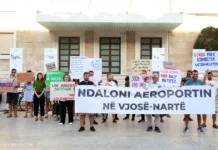
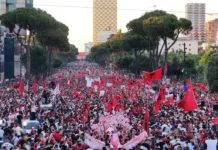
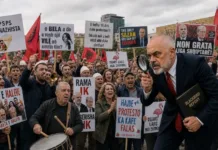
The Balluku case has sparked a wave of political and social reactions, becoming one of the most debated topics of recent weeks. While the debate on whether or not to lift the immunity of Deputy Prime Minister Belinda Balluku was taking place in the Assembly, civil society and new political forces organized protests and public pressure actions outside the Parliament premises.
With banners such as “No EU without justice” and “Tall in SPAK”, the protesters demanded equality before the law and a full investigation of high-ranking officials, opposing the use of parliamentary immunity as a defense mechanism against corruption charges. The protests were also accompanied by symbolic actions near the Ministry of Infrastructure and Energy, as well as a prolonged standoff in front of the Prime Minister’s Office.
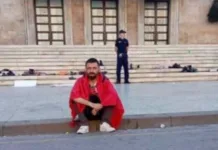
For more than 12 days, activists of the “Albania Becomes” party have been standing non-stop in front of the Prime Minister’s Office, demanding the resignation of Prime Minister Edi Rama and the creation of a transitional government with a 12-month mandate to guarantee free and democratic elections.
In parallel, the “Together Movement” party has organized several protests, where the demand has gone beyond Balluk’s resignation, including the prime minister’s confrontation with the judiciary. The MP of this political force, Redi Muçi, has publicly declared that he will vote in favor of lifting the deputy prime minister’s immunity, describing any other position as unacceptable.
The Democratic Party has also held weekly protests, considering the Balluku issue a symbol of what the opposition calls the degradation of the political system and the lack of space for parliamentary debate.
On December 16, 2025, SPAK officially requested the Albanian Parliament to authorize the arrest or deprivation of liberty of Belinda Balluku. The Deputy Prime Minister is accused of violating equality in tenders, specifically in the procedures for the Llogara Tunnel and the construction of the Tirana Ring Road, shifting the issue from a political debate to an important test for the functioning of justice.

Vjolanda Peca është diplomuar në Gazetari dhe Komunikim në Universitetin e Tiranës. Ka përvojë në gazetari investiguese dhe prodhim multimedial, duke punuar në Emisionin “Vetting” në News24 dhe në Faktoje.al, ku ka zhvilluar aftësi në hulumtim, verifikim faktesh, intervista në terren dhe prodhim përmbajtjesh për publikim online. Fokusi i saj është krijimi i përmbajtjeve informative që angazhojnë audiencën dhe ofrojnë informacion të thelluar.