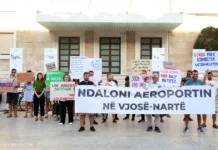

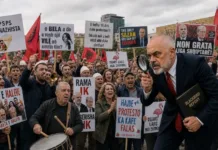
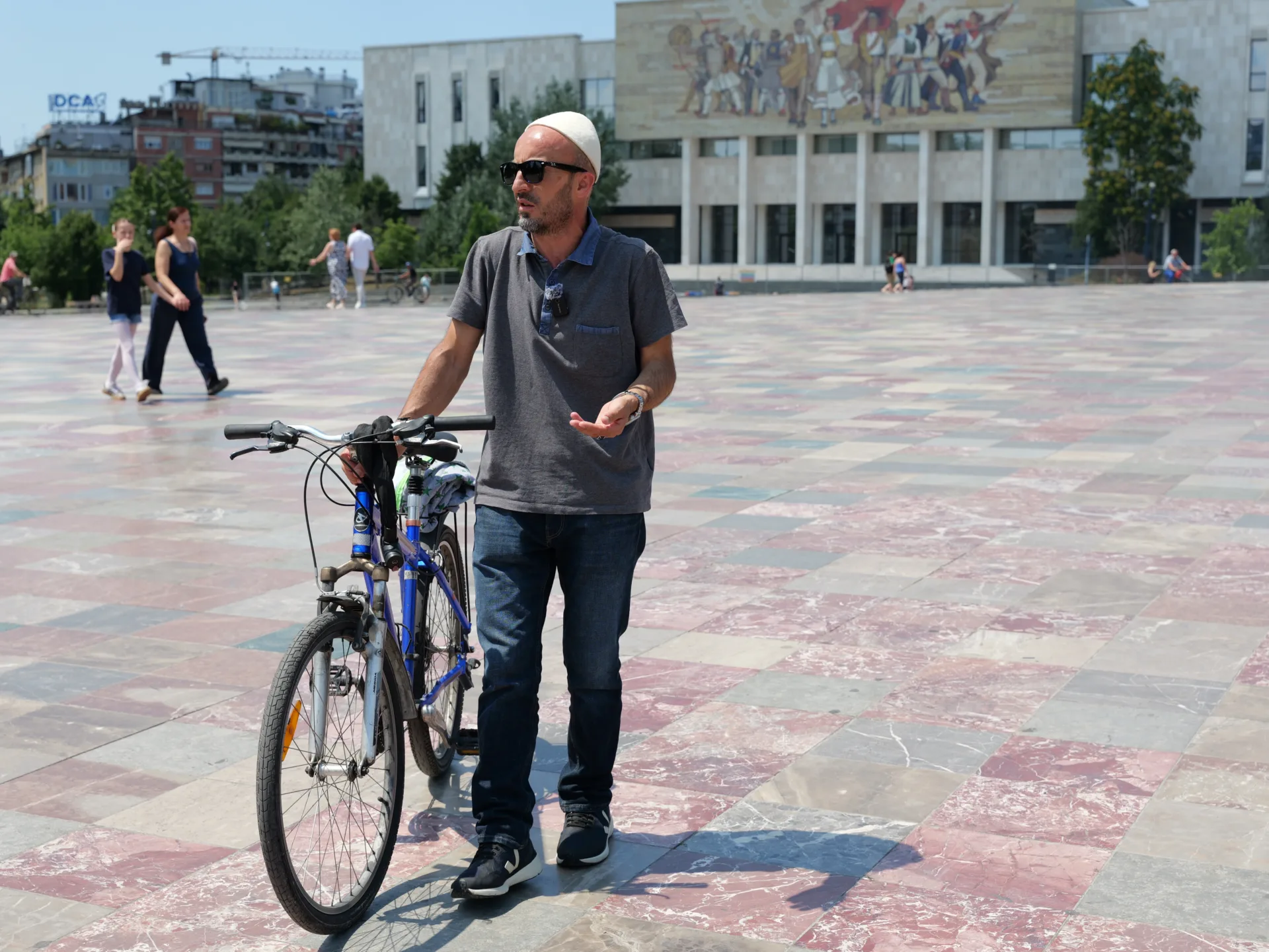
When the international news agency Reuters was reporting from the Narta Lagoon on the protests against the Vlora airport, among the environmentalists holding banners and opposing the construction near the flamingo habitat was Arben Kola. Reuters identified him as a tour guide and activist who warned that uncontrolled development would not bring progress, but destruction.
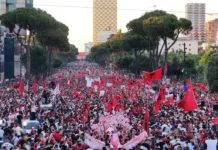
Years later, when the flamingos of Narta became the symbol of the civic revolt that swept Albania, Arben Kola’s name once again found itself at the center of a battle that had already transcended the boundaries of environmentalism. What began as opposition to projects in protected areas turned into a national movement against corruption, oligarchy, and the way of governance.
There are people who enter public life through parties. There are others who become known through positions, power, or career. Arben Kola belongs to another category: those who come out because they can’t stand to be spectators.
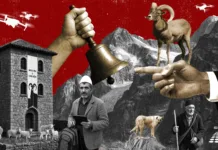
For more than a decade, he has been one of the consistent voices of environmental activism in Albania. He does not present himself as a politician, nor as a leader. On the contrary, he insists that he is a citizen who started the battle from his birthplace, in the Luma region, among the Kukes mountains, where his childhood was shaped by nature, rivers and the sounds of birds.
“My best friends were nature, birds, and the gurgling of the stream,” he says, linking his environmental sensitivity not to theories or organizations, but to the way he was raised.
Kola sees environmental protection as a matter of existence. For him, the damage to rivers, forests, and public spaces is not just an ecological problem; it is a social, cultural, and national scourge.
“Let me start with my village, the village of Bele in Kukës. The Gryka e Vanave, which we call Gryka e Vonave, is among the first to be massacred. 9 hydroelectric power plants have been built there. There are hundreds of rivers that have been massacred, especially in the Librazhd area, which no one talks about,” says Arben.
He speaks angrily about the hydroelectric power plants being built, the battles in Valbona, the Vjosa, the Cem River, and the Holta Canyon. In each of these conflicts, he has been present, sometimes in protests, sometimes in civic organizations, sometimes as a critical voice in international forums.
In 2018, he participated in an event at the European Parliament as an environmental activist, an experience he cites as evidence that Albania’s issues are not just local problems, but part of a broader European debate on development and nature protection.
“I gave a speech at the European Parliament about the environment. I was invited as an activist and I went with money in debt, so that Albanians would know,” Arbeni recounts.
Guides around Albania

Arben Kola is not a full-time activist. His profession is that of a tourist guide. He leads groups of foreign visitors around Albania, showing them the history, culture and landscapes of the country. It is precisely this profession that has made him even more sensitive to the transformations of the territory.
“I love, I adore the environment. We don’t live without the environment; the environment lives without us,” says Arben.
His stories often highlight the contrast between the Albania he promotes to tourists and the Albania he sees becoming concreted every day. He speaks with regret about the lost public spaces in Tirana, the lack of parks for children, and the construction that, according to him, is taking the breath away from the city.
“The protest is against that park that they stole from me, that park where I raised my son. They dug another hole and now my daughter and many children, this whole area that is Hoxha Tahsini’s area, Rruga Bardhyl, Rruga e Barrikadave, Zogu i Parë, do not have a park. This whole area does not have a park, a single park. The only park was behind the Opera and they sold it to us, these soul-sucking people,” Arben continues, explaining the reasons why he is at the forefront of the protest today.
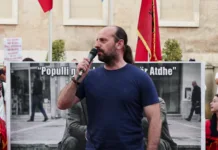
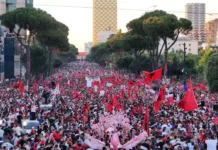
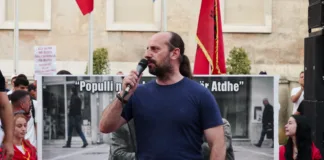
Those who know him describe him as direct, emotional, and uncompromising. He himself rejects the label of leader, but admits that he has often been on the front lines of organizing. In recent protests, he has become one of the most visible figures on the ground, helping to mobilize citizens and coordinate actions that have since taken on national proportions.
At the forefront of the protest


Arben says that everything started spontaneously, through contacts between activists and outraged citizens. He does not present himself as a sole organizer, but as part of a network of people who came together out of shared dissatisfaction.
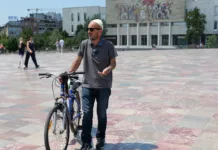
“On the 30th, as I remember, I was on a tour in Tirana. As you know, God brought to light that retreat that highlighted the barbarism of these oligarchs, politicians who are sucking the blood of this people. I saw that there was a revolt on the network. Luciana, since she has been fighting for 4 months, asked me to meet. That day, with that yellow vest, I was leading 2-3 Dutch groups on bicycles. At the same time, Luciana also contacted other activists,” Arben Kola recounts how the protest from Zvërnec moved to Tirana.
When describing those days, he recalls that he had just finished his job as a tour guide. He picked up a megaphone and headed to the protest. At first there were only a few people. Then the crowd grew, people joined in the march, and the energy of the revolt turned into a movement larger than the organizers themselves.
“I finished work at 6, at 6:10 I went and got the megaphone, at 6:15 I left and at 6:20 I was in front of the directorate. There weren’t many people at the directorate, but when we saw different figures that we hadn’t always seen, because just 1 day ago there were only 100 of us,” Arben continues to narrate.
What is striking in the way he speaks is his constant refusal to identify with politics. Kola insists that he is not seeking office, does not want a political career, and does not see himself as a candidate for power. On the contrary, he considers the role of activist as a kind of moral vigilance against power, whoever it may be.
“I am not a politician and I do not want to be in politics, I want to always be ahead of evil, because if all these so-called civil society, because I have also given civil society a nickname, pseudo-civil society, there is no civil society, there is a society with deceit.
“If someone like my profile and other activists enter politics, then who will be the example that in the future, when they deviate, who will stand up for them? We need to build something that will withstand the next 50 years, 100 years. Slowly, slowly, because there is a gap,” says Arben.
In many cases, his vocabulary becomes harsh and emotional. He uses strong metaphors, expressing anger at corruption, oligarchy, and the way in which, in his opinion, public resources have been managed.
Supporters see this as a sign of sincerity and civic revolt; critics may consider it excessive rhetoric. But regardless of your perspective, it’s hard not to notice the emotional intensity with which he lives his causes.
“I would say that there are some initiators, then there are many others and I don’t want to exclude anyone. What I want to convey through you: we who sacrifice the most and ask for nothing in return, except a democratic Albania, are being attacked the most,” says Arben.
At the heart of his worldview is the idea of responsibility towards future generations. He often talks about his children, the time he feels he has taken away from his family due to activism, and his desire to one day return to a more private life.
“I don’t want politics, I want a democratic Albania so I can return to my children, my daughter-in-law, because since my return from England in December 2010 I have stolen a lot of time from my daughter-in-law and she is the only person who can put my shoulders against the wall. So I want to stay with my children, I want to enjoy working in tourism,” he confesses.
What sets him apart is the fact that he doesn’t just link his cause to flamingos. For him, the flamingo is a symbol. A symbol of diverted rivers, cut down forests, lost parks, and a country that, according to him, is losing the balance between development and public interest.
“They told me: ‘Don’t, that’s why you’re stuck in a rented house, don’t do it’. And I said I would do my part, slowly, in that part of awareness. But this is a will of unborn children, of those who have been born, of those who are growing up, of youth, of the elderly, who have sacrificed a lot, and of God above. It is not something of either Ben or Hasan; it is a will that God has decided so that the Albanian people will not forget”, Arben Kola confesses.
One of the dreams he mentions is to open an education center for young people, where citizenship, integrity, and resistance to servility are taught. In his vision, long-term change comes not from endless protests, but from forming generations that do not accept injustice as normality.
“I feel it, it’s a telepathy that I probably inherited from childhood, having faith in God, but also in the mountain fairies, because my mother raised me with these stories and I can’t avoid it. If I have life, I want to open an education center for young people, for children, so that they don’t fall prey to servility, so that they don’t sell their souls, their bodies, so that they can establish the foundations once and for all and Albanians don’t protest, but become like the Swiss, the Norwegians, to fall into peace and enjoy what God has given us,” concludes Arben.
To understand Arben Kola, you have to imagine him as a man moving between two worlds.
Between the mountains of Luma that shaped him and the Tirana that revolts him; between the tourist groups he leads every day and the protests where he holds the megaphone; between the desire for a quiet family life and the conviction that he cannot remain silent in the face of what he considers wrong.
He does not present himself as a savior, nor as a politician. In his narrative, Arben Kola is simply a citizen who believes that love for the country begins with protecting the river, the park, the forest, and the right to raise his voice when he thinks they are being lost.

Xhesika Tollia është gazetare në “Rrjetin e Raportimit të Krimit të Organizuar dhe Korrupsionit në Shqipëri” (RRKOKSH), ku fokusohet në investigimin dhe raportimin e çështjeve të ndjeshme që lidhen me korrupsionin dhe krimin e organizuar. Ajo ka përfunduar studimet Master në Shkenca Politike në Universitetin e Tiranës, duke i dhënë një bazë të fortë akademike njohurive të saj mbi institucionet, politikën dhe proceset ligjore në Shqipëri.
Gjatë karrierës së saj, Xhesika ka zhvilluar eksperiencë të rëndësishme pranë RTSH-së, ku është përfshirë në përgatitjen dhe realizimin e projekteve mediatike, duke ndihmuar në prodhimin e përmbajtjeve të thelluara dhe informuese për publikun. Ajo është e njohur për qasjen e saj të kujdesshme dhe analitike ndaj lajmeve, duke kombinuar investigimin me raportimin objektiv dhe të detajuar.