





Tirana had not seen such civic mobilization in years.
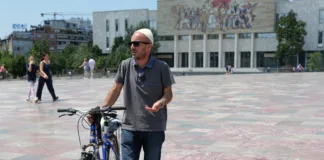
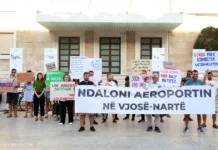
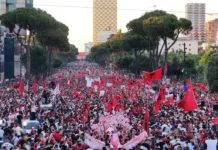
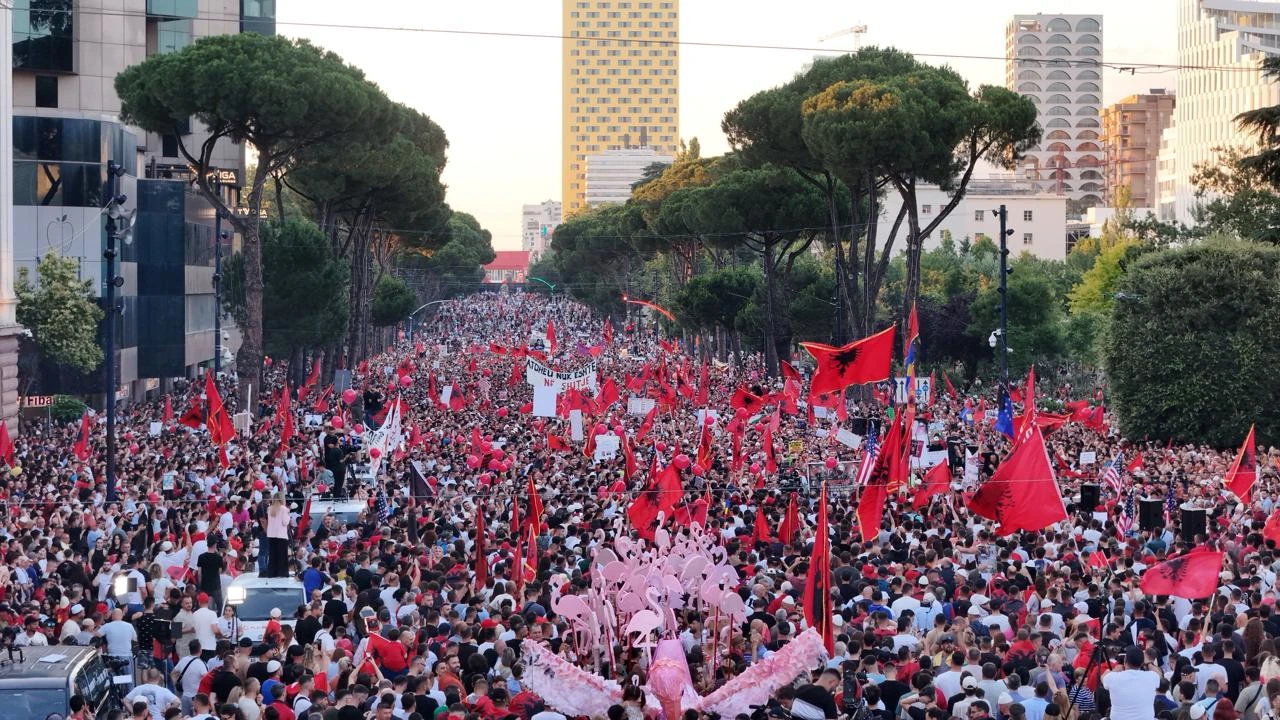
In the early hours of Saturday, the streets leading to the center began to fill with people. Some had come from Vlora, Shkodra and Korça. Others had traveled from London, Milan, Athens and Berlin. They were not united by a political party, nor by a charismatic leader. They were united by the conviction that Albania was selling something that should not be sold.
When the protesters arrived on the boulevard, pink flamingos were everywhere. On banners, on flags, on cardboard masks held by children. The bird has become the symbol of the biggest civic revolt the country has seen in years.
Chants of “Rama go” and “Albania is not for sale” echoed along the boulevard, as many protesters demanded not only the removal of Prime Minister Edi Rama, but also the end of the political system that, according to them, has produced mass emigration, inequality, and a loss of trust in institutions.
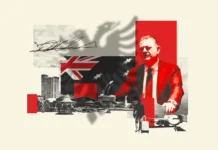
What began a few weeks ago as opposition to the multi-billion dollar project linked to Jared Kushner and Ivanka Trump on Sazan Island and the Narta protected area has turned into a broad movement against corruption, lack of transparency, and the political model that has dominated the country for more than three decades.
Protesters believe that the agreement to develop luxury resorts is not just a tourist project, but the most visible symbol of a system where decisions are made away from the public eye and where the economic interests of a few outweigh the national interest.


For thousands of Albanians who took to the streets of Tirana, the issue has become a symbol of years of accumulated dissatisfaction with corruption, the lack of meritocracy, the emigration of young people, and the feeling that major decisions are being made far from the public interest.
Therefore, at the heart of the protest were two slogans that were constantly repeated: “Albania is not for sale” and “Rama is out.” But, alongside them, another call was also heard: “Berisha is out.” For the first time in many years, the anger of citizens was not directed only at the government. It was directed against the entire political class. Many protesters see the ongoing conflict between socialists and democrats as a worn-out cycle that has produced neither justice, nor development, nor hope for the new generation.
Among the crowd were students talking about the mass exodus of young people from the country. There were entrepreneurs complaining about the struggling economy. There were environmentalists warning about the irreversible damage to the Narta ecosystem. There were families holding banners that read: “We are not just protecting flamingos. We are protecting our future.”
Many of them do not oppose foreign investment. They oppose the way in which, in their opinion, these investments are being made. This is precisely what has helped the movement gain support beyond traditional environmental groups.
Prime Minister Edi Rama’s government has rejected this narrative. Rama has defended the project as a historic investment that will transform Albanian tourism, create jobs and position the country on the map of elite Mediterranean destinations. According to him, the project will be developed according to international standards and with full environmental assessments.
The Prime Minister has stated that there is no possibility of the project being stopped and has suggested that the protests have been fueled by disinformation, political interests and even foreign actors seeking to destabilize the country.
However, the more the government has insisted on continuing the project, the more discontent has grown on the streets.
Saturday’s protest showed that, for many citizens, the issue is no longer just about a luxury resort or a protected lagoon. It is about lost trust in institutions.
In a country where immigration continues to empty entire cities, where corruption remains among the public’s main concerns, and where the European integration process is seen as the last hope for real reforms, the Flamingo Revolution has become a reflection of the crisis of trust between citizens and politics.
At the end of the day, flamingos may have been the reason that brought people together, but the message that came out of Tirana was much bigger. A part of Albanian society is demanding not only the protection of nature, but a new contract between citizens and the state.
And for this very reason, the “Flamingo Revolution” may go down in history not as a protest for some rare birds, but as the moment when thousands of Albanians took to the streets of Tirana to protest against corruption, the lack of meritocracy, the emigration of young people, and for the restoration of hope for a better Albania.


Lindita Çela është një gazetare investigative e shquar, e njohur për raportimet e saj të përpikta dhe të guximshme mbi krimin e organizuar dhe korrupsionin në Shqipëri. Me një karrierë që shtrihet për mbi dy dekada, Çela është konsoliduar si një figurë e rëndësishme në fushën e gazetarisë investigative, duke fituar vlerësime si në nivel kombëtar ashtu edhe ndërkombëtar për punën e saj.