



Street revolt and political transformation


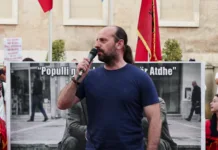
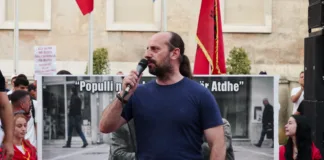
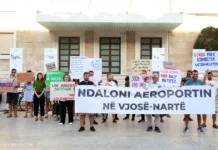
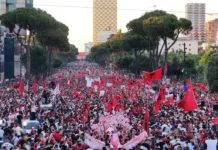
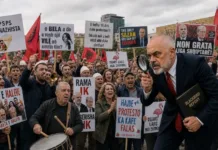
The cries of “Rama, resign”, “Rama in prison”, “Berisha in prison” are expressions of a dissatisfaction accumulated over years. They demonstrate a deep distrust that goes beyond power: citizens no longer trust the opposition, the media, the economic elite or the university/academic elites. Essentially, today the very functioning of the system is being contested.
The spread of the protest in the diaspora makes this reality even clearer. It is not simply related to a specific decision or project; it is a revolt against a development model that does not produce opportunities for the majority. A model that expels thousands of young people every year through emigration and that is perceived as a mechanism that works for a minority, but has stalled for the rest of society.
What is felt in the air is the urgent demand for change. Except that change should not be confused with revenge. If calls for prison turn into a demand for justice to be delivered by the crowd, then we risk going back in time. Albania has once tried the logic where the enemy was declared in the square and the decision was given before the court spoke. We have paid the consequences of that political culture for decades, building the most savage communism in the entire Communist East.
Therefore, beyond the classical logic of historical revolutions that collapse everything to often bring about a new arbitrariness, overcoming this crisis requires a profound institutional transformation, not the dissolution of the state. True radical change does not come when institutions are replaced by the squares, but when they are freed from political capture and gain the trust of citizens, strengthening the rule of law.
A famous quote by John F. Kennedy remains unfortunately relevant: “Those who make peaceful revolution impossible, make violent revolution inevitable.” This is where the turning point must begin.
The majority’s contentment with a formal declaration that “the right to protest is respected,” counting the protesters and waiting for people to be driven away by the heat, the World Cup, or fatigue, is as naive as it is dangerous.
The opposition is also faced with a clear message. For years, voters have been offered a choice: either with one or with the other. Protesters are saying: neither with one nor with the other. This does not mean that the opposition has not raised real problems or has not made strong denunciations and protests. But the protests of these two weeks are proving that there is a large segment of citizens who no longer find representation among existing political actors. This requires reflection, renewal and the ability to be in sync with the situation.
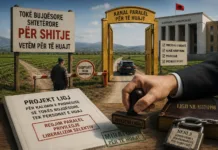
If until now there has been a lack of will to fight corruption, clientelism, and monopolies, the question that arises today is: can a new political will be created? A model where success depends on meritocracy and where the market is not deformed by the privileges of power.
The big question hanging over the squares is whether this street pressure will remain an amorphous pressure movement or will have the courage and maturity to take the form of a new political movement. History teaches us that revolt without organization simply recycles old elites. For this momentum not to be dissipated as the next wave, it must overcome the phase of rejection and return to structure: a new platform, born from below, that does not simply aim to replace names, but to transform the rules of the game and represent that Albania that today does not find itself in any existing logo. Whatever happens, the protest has already changed Albania.
Reflection is also required from the economic elite. The debate is not whether to punish success or capital, but how fair the market is. When the gap between winners and losers widens alarmingly, the system risks imploding. Just as rampant communism left its consequences, rampant capitalism also has its social costs. Big business (the oligarchs) must break away from its dependence on public tenders and political favors, orienting itself towards social responsibility, dignified wage growth and clean competition.
Reflection is also required from universities and academia. In many of the most important public debates, the voice of expertise has been absent or weak. A society cannot rely solely on politicians and analysts. The country also needs the critical thinking of researchers, professors and academic institutions, to offer scientific solutions to the demographic decline, as well as electoral, territorial, economic and educational reforms.
Citizens are fed up with the banal and endless debates in the media; they need information, not propaganda; analysis, not labeling. The media must return to its mission: investigating, verifying facts, and keeping power under scrutiny. It can neither be a government mouthpiece nor a people’s court that carries out digital lynchings.
Of course, in any mass protest there is anger and emotions that occasionally go to extremes. But legitimate discontent cannot justify verbal violence or lynching anyone who thinks differently, even journalists identified as defenders of the government. Freedom of expression is the fundamental element that separates a civil protest from anarchy. Lynching is the opposite of peaceful protest.
Change has never been easy; it requires patience, sacrifice, and maturity. But today, the main responsibility falls on those who hold the wheel of decision-making. History shows that major crises are not resolved by waiting for time to fade them. Will the message of the protest for change be read in time, or will we continue with the old one, waiting for the storm to pass by itself?