








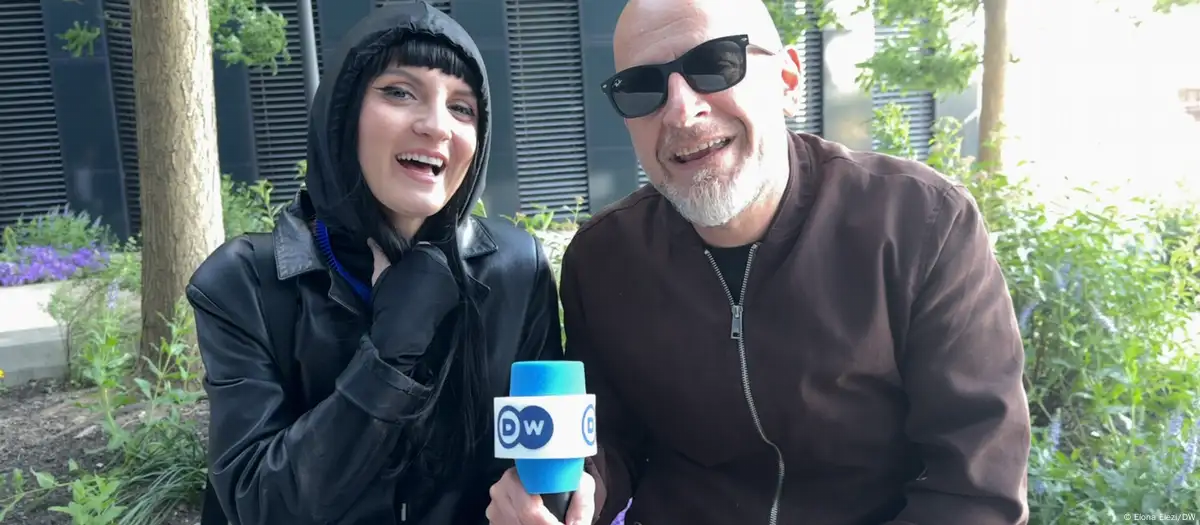
In the lobby of a hotel in Basel, Switzerland, journalists covering the European song festival “Eurovision Song Contest” line up to interview the singers who have managed to climb the stage of the grand final on May 17.
To meet and interview Beatriçe Gjergji and Kolë Lacë, the duo of “Shkodra Elektronike”, one has to wait a long time. Interest in them is great. Journalists from all over the world want to know everything about this year’s representatives of Albania, from the lyrics of the song, the clothing, the stage movements, the ambitions, the expectations. The questions are endless and their fatigue is visible, yet they find time to give honest and truthful answers to everyone interested, with a smile that never leaves their portrait.
The conception of “Electronic Shkodra”

Although both born in Shkodra and immigrated to Italy early on, Beatriçja and Kola did not know each other before, but were found by chance on social networks, while each had their own musical group.
“With Kola, we were found on the internet. We are a symbol of the times we live in,” Beatriçe Gjergji tells DW. The desire to recreate a cover of the Shkodra song “Turtulleshë” made her search YouTube before proposing the song to her Italian friends, where she found an earlier cover that Kola had sung with his band.
“It was a very beautiful cover and something completely new, unheard of before, and I really liked it. I was thrilled.”
Then curiosity made her want to know more about Kola and she listened to his interviews, where she learned that he was also from Shkodra, an immigrant in the 90s, and found many similarities with her life story. Then they communicated on Facebook and after following each other’s musical activity from afar, they met and started talking about collaboration, until in 2019 they created “Shkodra Elektronike”.
The culmination of their artistic collaboration is writing the song for the Albanian Radio-Television End-of-Year Festival, the victory of which brought them to the gigantic Eurovision stage.
“Good people and nameless people dance in the soul” – is one of the verses of “Zjerm”.
“When I started writing the song, I thought about writing about good people, people who, when they get nervous, don’t react badly. I wrote it about people with empathy, and I’ve been lucky enough to know many of them, who have left a big mark on me and I’ve learned a lot from them,” says Beatrice.
“Immigrants of the ’90s”

Kolë Laca was 20 years old when he decided to study in Italy. In Shkodra, he had studied piano at the lyceum but had never felt free to make the music he wanted.
“I finished my studies and ended it there with music, because we are talking about a school under communism, where no one was free to do whatever they wanted,” Kola tells DW.
But the system fell and Kola still couldn’t find himself in Albania. Through a scholarship from the Jesuit school in Shkodra, he decided in 1992 to study law in Padua, Italy, a field he later changed to political science, where he graduated.
But in a free and developed music market like Italy, he returned to music, but this time not classical music but underground music.
“There I started from scratch with music. I remember that the first thing I did when I arrived in Padua was buy a newspaper announcing the musical activities that would take place in the coming months and I saw that the band ‘Aerosmith’ was coming. I went to see them and there I understood psychologically and physically the big difference with the Albania of those years” – says Kola.
He doesn’t stop talking at length about the difficulties of the beginning, because in 33 years of living in Italy, he says he has had enough time to forget everything.
While Beatrice was only 6 years old when her family emigrated to Italy, after another emigration experience they had previously had in Germany.
“Italy has not been easy, especially for my parents. But in their eyes I have never seen fear, but only dignity. That is why my life has been colorful and has never been boring,” says Beatrice, who feels lucky that in her life two different worlds, the Albanian and the Italian, have been able to beautifully intertwine.
“Class musicians”

“Did you hear Albania? What class they have. They deserve to be at least in the winning three.”
This is the sentence that a journalist says to his colleague next to him, as “Shkodra Elektronike” concludes the last stage rehearsal before the grand finale on May 17. By the organizers, Albania has been selected to be the last song listed in the competition, with number 26.
“It is an unusual decision that we have left San Marino penultimate, and Albania last. Because San Marino is fun, a rhythmic song where everyone dances. But on the other hand, they wanted to close it with a choice that is truly classy and represents music. And this is Albania’s song. There is a lot of talent, intelligence, and it is a very beautiful song. We could have left Albania penultimate and San Marino last, but it is more right to close this festival with a classy act” – said a few hours before the final Christer Björkman, one of the longest-serving producers of the Eurovision Song Contest.
Experts and festival enthusiasts have long debated the importance of the order of the songs on the final night, with many believing that singers who perform in the second half of the competition do not have a better chance of winning. However, in recent years, some of the winners have been listed at the end of the competition, such as Italy with Maneski in 24th place (2021) or Ukraine with Jamala in 21st place in 2016.
Note: Where text is taken from DW

