




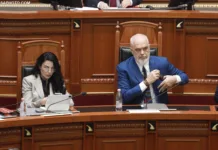


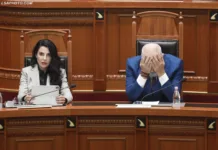











Two days after the murder of Appeals Judge Astrit Kalaja, 260 judges from across Albania gathered at the Justice Pole to discuss the lack of security in courtrooms and the political rhetoric that, according to them, has undermined the authority and independence of the judicial system.
The magistrates also spoke about problems in law enforcement, limited control over justice officials, and the lack of a sustainable strategy for preventing criminal acts against them.
The head of the Supreme Court, Sokol Sadushi, called the event a “death foretold,” directly linking it to harsh political rhetoric that, according to him, has undermined the respect and authority of the judiciary, reinforcing the perception that self-justification arises when justice is influenced by fear and public pressure.
Prime Minister Edi Rama used the event to announce changes to legislation that would lead to a tougher Penal Code, and why he himself has used harsh and ironic language towards some judges, calling them “homeless” and “scoundrels.”
Representatives of the judicial system, such as Sokol Sadushi, head of the Supreme Court, and Arben Rakipi, head of the School of Magistrates, lawyers such as Dorian Matlija, constitutionalist Jordan Daci, agree that unilateral intervention through the Criminal Code does not solve the problem.
They emphasize that the greatest need is for preventive measures, security monitoring, legal awareness, and harmonization with European standards, emphasizing that harsh political rhetoric can undermine citizens’ trust in justice.
Political rhetoric that fuels hatred

From the Justice Center building, the head of the Supreme Court, Sokol Sadushi, described the murder of Appeals judge Astrit Kalaja as a “death foretold” and a consequence of the continuous denigration of judges by politicians and, not infrequently, by the executive branch.
“This is a death foretold. For years, judges have been the target of insults, threats and denigration. Instead of protecting the independence of the judiciary, its authority has been attacked. Instead of building respect for justice, contempt for it has been encouraged,” declared the head of the Supreme Court.
According to Sadushi, what happened in that courtroom was just the culmination of a “rage” that has been building for years.
And one of them seems to have been the country’s prime minister, who during the summer and fall of 2025 almost created a smear campaign against judges and prosecutors.
In his repeated reactions on Facebook, during the summer and fall of 2025, Prime Minister Edi Rama has publicly attacked justice officials, accusing them of “anti-law”, “anti-state” and for decisions that, according to him, violate the public interest and government programs.
He has used harsh and ironic language towards magistrates such as Balliu, Demiri, Ligoraq, Boshku and prosecutor Gjeli, describing them as “without a homeland”, “without knowledge and faith”, “scoundrels” or “wolves with livers in their necks”.
He warned that the government will no longer remain silent in the face of “abuses of the independence of justice”, emphasizing that “those who mock the interests of the state will face their wrongdoing not only in the bodies of judicial self-government, but also in the eyes of public opinion”.
In all reactions, Rama calls for the intervention of the institutions of self-government of justice (KLGJ, ILD) and denounces their “calmness” in the face of cases that, according to him, show that the “old justice” still exists within the new system, the reform of which is often overlooked.
For lawyer Dorian Matlija, it is precisely this political narrative that fuels hatred towards the judiciary.
“There is a great risk that the political narrative, and especially the rhetoric of power, will fuel hatred, uncertainty and distrust towards the justice system. When figures like the Prime Minister use antagonistic rhetoric towards the judiciary, the public who do not have technical knowledge of the system and the laws in general tend to believe that the judiciary is part of the problem, not the solution,” says the lawyer.
Matlija explains that blame-shifting mechanisms are often used by the government, blaming the judiciary for the system’s failures, while real responsibility for the laws and experimental reform that damaged the capacities of the judiciary is often ignored.
“The government avoids its responsibilities by drawing attention to the judiciary that ‘does not give proper decisions’. This creates a narrative that the judiciary is to blame and not politics that drafts evil laws, and in collaboration with irresponsible international factors they also crushed the capacities of the judiciary through a failed experimental reform,” adds Matlija.
According to the lawyer, strengthening justice does not depend on toughening the Criminal Code, but on the real functioning of the system and building a narrative that supports trust in the judiciary, not on political rhetoric that labels it as an enemy.
Constitutionalist Jordan Daci believes that the political narrative is not the main cause of the public’s negative perception of justice.
“Politics is the mother of many problems and influences wrong decision-making, but the narrative of the judiciary, caused by the system itself, has a greater impact. For example, a judge who handles a case with a humane and fair approach will never receive any remarks, while “inhumane” decisions can cause criticism, insults and threats,” he says.
According to him, our system is on the verge of a total collapse that requires immediate solutions.
“Although there is talk of around 200 thousand cases or more, including the two courts and the cases of 2016-2017, nothing is being done to face this crisis. If urgent intervention is not made, the situation will be very alarming and could produce serious cases, even loss of life,” adds Daci, also emphasizing the importance of a humane and equal justice system where the system should help citizens and maintain social balance, not turn into a political instrument.
With an iron fist, prison…prison…prison

Prime Minister Edi Rama, after the murder of the Appeals Court judge, proposed toughening the Criminal Code, linking this tragic event to the need to strengthen security and punishment for illegal actions.
“I believe this tragic event is the most irrefutable argument to support the significant tightening of the penalty for illegal possession of weapons in the Criminal Code,” he stated.
But this approach has faced strong criticism from justice experts, who emphasize that the problem lies not with the laws, but with the lack of effective implementation, poor infrastructure, and politicized rhetoric towards the judiciary.
They see this proposal as an emotional and political reaction to serious events, more than a thoughtful strategy for building a fairer system.
Arben Rakipi, head of the School of Magistrates, considers the strengthening of the Criminal Code as an insufficient measure in the face of the deep causes of the justice crisis.
He emphasizes that “the quality of criminal law is a premise that contains the possibility of preventing crimes, but it remains insufficient”, adding that “never in Albania has the law, and criminal law in particular, been an obstacle to the smooth running of institutional life”.
For Rakipi, the problem lies in “implementation with multiple standards, lack of legal awareness and the spread of corruption”, which according to him “undoes the law because it has become a way of life”.
“Everyone who is amplified by public communication is a present cause in sketching the portrait of justice as the black sheep of the country. It is openly despised, denigrated, slandered, abused in its name, encouraged to work with certain standards, trampled on out of fear by pushing it into a corner where it must wait and endure the hatred of the mass or the crowd. This is the highest service rendered to the anti-state. Unfortunately, justice itself continues to not understand or act as such that it governs itself independently and must show that it is such, justice in public service equal for all.” – says Rakipi.
For Lawyer Dorian Matlija, toughening the Criminal Code is not the right path to strengthening the justice system, as the current law provides for severe penalties, such as in Article 79/a for the murder of judges, which is punishable by life imprisonment or no less than thirty years.
However, Matlija argues that even extreme punishments do not deter crime when actors do not act rationally.
“From international experience, extreme sentences usually do not have a deterrent effect in cases committed by people who do not make rational calculations before committing the crime,” says Matlija, according to whom the main problem is the lack of security in and outside courtrooms.
“In the case of the murder of judge Astrit Kalaja, the biggest problem was not the Criminal Code, which clearly punishes to the maximum, but rather the security in and outside the courtroom, the lack of physical controls, adequate guards, monitoring, and the assessment of the increased risk for some officials.” – continues the lawyer, according to whom the political proposal to toughen the law seems like rhetoric to attract attention, not a real strategy for justice.
“The Prime Minister, in his speeches, often uses the rhetoric of the need for a tougher criminal code as a political tool to attract attention and not as a real reflection of a sustainable strategy for justice,” says the lawyer.
For constitutionalist Jordan Daci, strengthening justice is not achieved through toughening criminal laws, but through improving the functioning of the system.
“All ideas that aim to strengthen justice through criminal laws are, in principle, wrong. A fair, independent and accountable system is not measured by the severity of criminal decisions, but by the easy access of citizens to the system, the removal of obstacles to participation in the judicial process, the resolution of cases in a quick and fair manner, and the preservation of social balances” – argues Daci, according to whom interventions in the criminal code are the last resort.
The constitutionalist argues that criminal law should be an instrument for the functioning of the system, not for solving the problems of individuals who violate the law.
He cites the case of illegal possession of weapons, where the changes in the law were inconsistent and illogical in relation to the penalties for more serious crimes. Constitutional Court decisions later overturned this approach, showing that strengthening justice is not achieved with harsh laws, but with a functional and efficient system.
“Strengthening justice is done by increasing efficiency, reducing costs, and making the system fairer and more accessible to citizens. The endemic problems of the system have not been addressed by previous reforms, and interventions in the Criminal Code should be the last resort, not the first resort. Any ill-considered change could transform the system into an instrument of the state over the individual, undermining fundamental rights and freedoms,” he concludes.
Meanwhile, political scientist Alban Daci argues that the solution to the problem of the justice system lies in harmonizing norms with European laws.
“Albania has a good experience of laws, normative acts, provisions and does not need a ‘tabula rasa’, but to update the existing one by bringing it closer, first of all, to harmony with EU norms as an essential condition for Albania’s full membership. If in the legal dialectic the term ‘strengthening’ is used, which contains the word ‘force’, we will not achieve an accepted justice, but perhaps we will continue to have a justice dictated beyond the social, economic realities and the democratic spirit that Albania should have.” – says political scientist Alban Daci.

Gazetare në “Rrjetin e Raportimit të Krimit të Organizuar dhe Korrupsionit në Shqipëri”- RRKOKSH.