










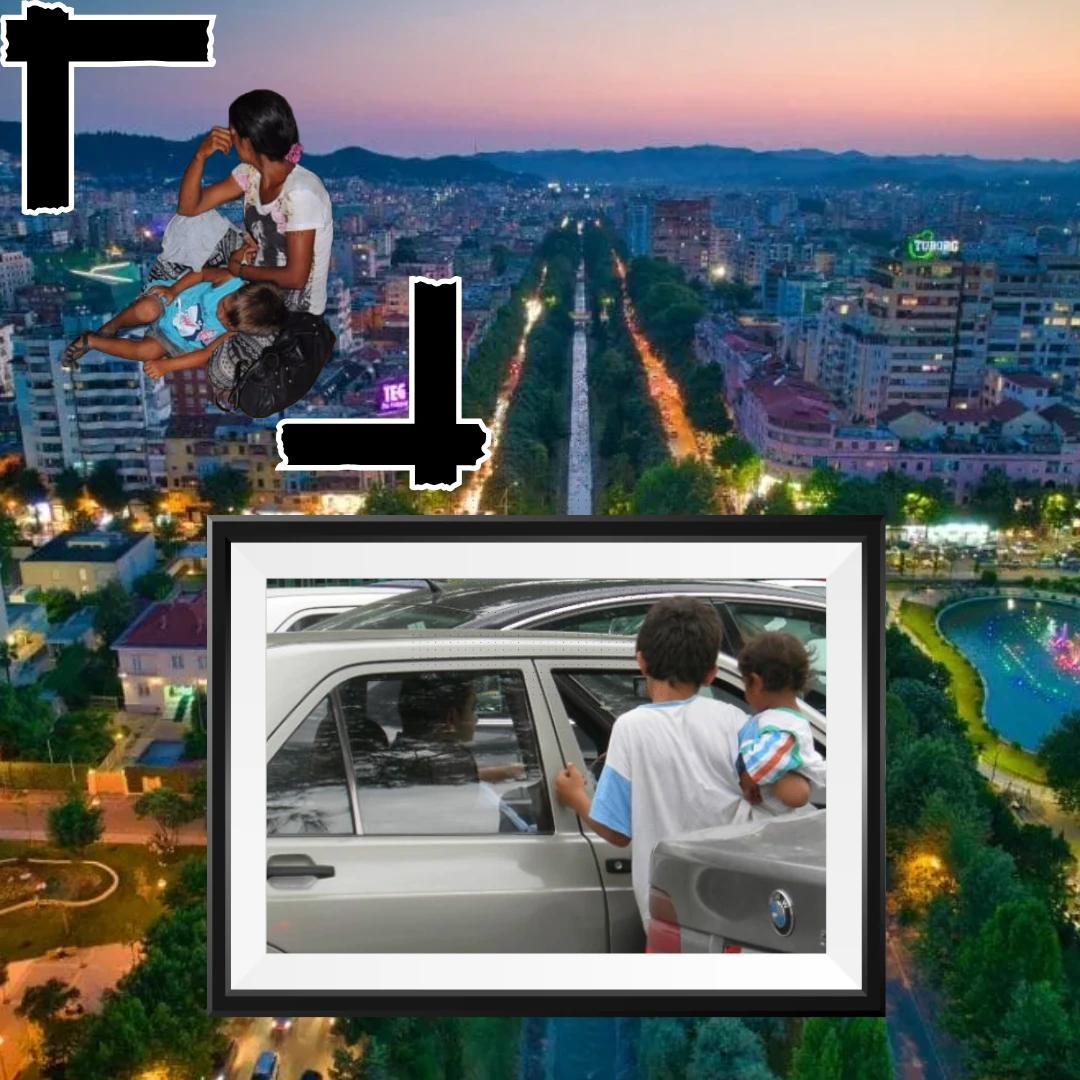
For years, children begging or working on the streets of Albanian cities have become a sad part of urban everyday life.
The National Hotline “Alo 116 111” reports 344 cases of exploitation of children for profit in just one year, but the cases recorded and processed by the State Police are far from the figures of children’s rights organizations in the country.
According to official State Police data, in 2024, 54 cases of exploitation of street children were processed throughout the country, while during the period January-May 2025, only two cases were processed, one in Tirana and one in Durrës.
But the figures reported by the National Children’s Hotline “Alo 116 111” are many times higher. In the first four months of this year alone, the organization says it has handled 87 cases of child exploitation, involving 190 minors, while in 2024, 256 cases involving 473 children were reported.
Although state institutions report minimal figures for criminal proceedings on their exploitation, child rights organizations are alarmed by a widespread and recurring phenomenon. A stark contrast between official statistics and the reality on the ground speaks to a serious problem of institutional lack of intervention and coordination.
Tirana, the epicenter of exploitation
In the area known as the “7 Dwarves”, two minors stand every day under the trees along the Lana River, sometimes to protect themselves from the strong rays of the sun and sometimes from the rain. As soon as the traffic light turns green for pedestrians, they approach the car windows. One to clean them and the other to sell one of the red roses he holds in his hands.
There are days when he might sell a few roses, but the minor is there every day looking for buyers who travel to this intersection in the capital. The two minors are not the only ones who earn an income on the streets of Tirana.
Some of them work, others go to bars to beg for alms from citizens who consume coffee.
In an area regularly patrolled by police, no one stops the presence of children on the streets.
According to Albanian legislation, “any police officer who finds a child in high and immediate danger shall take the child into protection and immediately notify the child protection officer in the territory where the child is.”
The law also obliges local governments and the Child Protection Unit to exchange information with local police to intervene against child exploitation, even in street situations. But in practice, this chain does not function properly.
According to Altin Hazizaj, head of CRCA/ECPAT, “there is no integrated child protection system in Albania. Institutions at the local level do not have the necessary capacities, services are fragmented and there is no systematic follow-up of cases.” He emphasizes that one of the main problems is the lack of updated data.
“The last study on this phenomenon dates back to 2015–2017 and included around 2,500–3,000 children in street situations, from begging to sexual exploitation. Today, there is no clear picture of the real extent of the problem,” says Hazizaj.
According to data from the National Children’s Hotline “Alo 116 111”, during the first 4 months of this year, 2025 alone, 87 cases of exploitation of minors for profit were reported to this organization.
“Of these 87 reported cases, 190 children were affected,” the organization specifies, but from the official data that the State Police made available for the same period, only 2 cases were reported to the prosecutor’s office, one in Tirana and the other in Durrës.
In 2024, 256 cases involving 473 children were reported, but again, according to the Police, only 54 cases were processed, mainly in Durrës and Tirana.
Belioza Çoku, the head of the organization, claims that the vast majority of identified cases are repeated and well-known, but no concrete measures are taken against them.
According to Çoku, 97% of the identified cases were reported to the Community Field Center team in Tirana. While the cases identified in other cities were reported to the police or child protection units in each municipality.
Meanwhile, in the Durrës Court, there are no cases under consideration for the criminal offense of child exploitation.
Despite the reports, the problems of child exploitation remain the same.
“The challenges are the repeated cases and well-known by the Field Teams. We have repeated cases for years that have not been taken action” – says Çoku, while according to the data that “shteg.org” has, it turns out that the processed cases are far from the figures of non-profit organizations, but also of the State Agency for the Rights and Protection of Children itself.
The streets, a workplace for hundreds of minors

The exploitation of street children is not a new phenomenon in Albania. In 2023 alone, according to the report of the State Agency for Children’s Rights and Protection, 182 cases of children in street situations were treated in the country’s municipal units.
Meanwhile, Tana Aliaj, representative of the Institute of Roma Culture in Albania (IRCA), says that even last year, 2024, the recorded cases of exploitation of children in street situations were high.
“In Tirana alone, the Community Outreach Center identified 240 cases in 2024, with 102 cases in the first quarter of the year alone. While some of them are involved in community services, many of them return to the streets for economic reasons,” says Aliaj.
Statistics but also reality for Altin Hazizaj is an indicator that the exploitation of minors is one of the issues where every effort by the Albanian state has failed.
“Here, including the government at the central level, all those institutions that have the duty to fight this phenomenon that is so ugly and so disturbing to children’s rights, where without question, without forgetting that the municipality where this phenomenon occurs and the family have direct responsibility,” says Hazizaj.
According to the director of the Center for Children’s Rights, one of the main reasons why the number of exploited children is high is related to poor social services at the municipal level, while emphasizing that a study on this phenomenon has not been conducted in Albania for years.
“The latest study is from 2015-2017 and it concerns around 2500-3000 exploited children living in street situations, which includes all forms of exploitation, from begging, selling to sexual exploitation of children” – says Hazizaj, while in the annual report of “Alo 116 111” during 2016, 3400 calls from Tirana were recorded where children or citizens expressed concerns about minors.
The lack of a proper study for more than 7 years, insufficient social services, and increased tourism are further increasing the risk of child exploitation, including sexual exploitation.
Tirana, according to Hazizaj, remains the city where children are exploited the most and in all forms.
“The arrival of foreign tourists exposes this entire group of children to sexual exploitation, and taking into account the number of children living in poverty, which is almost 40% of children in Albania, it means that 40% of children are all contingent, all potentially exposed to forms of exploitation, including sexual exploitation,” Hazizaj concludes.

Dallandyshe Xhaferri është gazetare në "Rrjetin e Raportimit të Krimit të Organizuar dhe Korrupsionit në Shqipëri" - RRKOKSH. Ajo ka studiuar Gazetari në Universitetin “Aleksandër Xhuvani” dhe ka marrë pjesë në shkëmbime studentore në Poloni dhe SHBA. Në Poloni, ka ndjekur një semestër në "Journalism and Management" në Universitetin "Papa Gjon Pali II", ndërsa në SHBA ka marrë leksione mbi gazetarinë në Kolegjin e Bostonit. Gjatë katër viteve të fundit, ajo ka punuar si gazetare në organizata të ndryshme me fokus gazetarinë cilësore dhe ka qenë e angazhuar në projekte të IFES, East West Management Institute dhe Rana Labs.