










At a time when Albania aspires to open chapters 11 and 12 of the negotiations with the European Union, related to food safety and veterinary services, the reality on the ground presents an alarming situation. Scandals with contaminated food, the malfunctioning of responsible institutions and the decline of the livestock sector have become daily parts of the life of the Albanian consumer, who is increasingly faced with serious health risks.
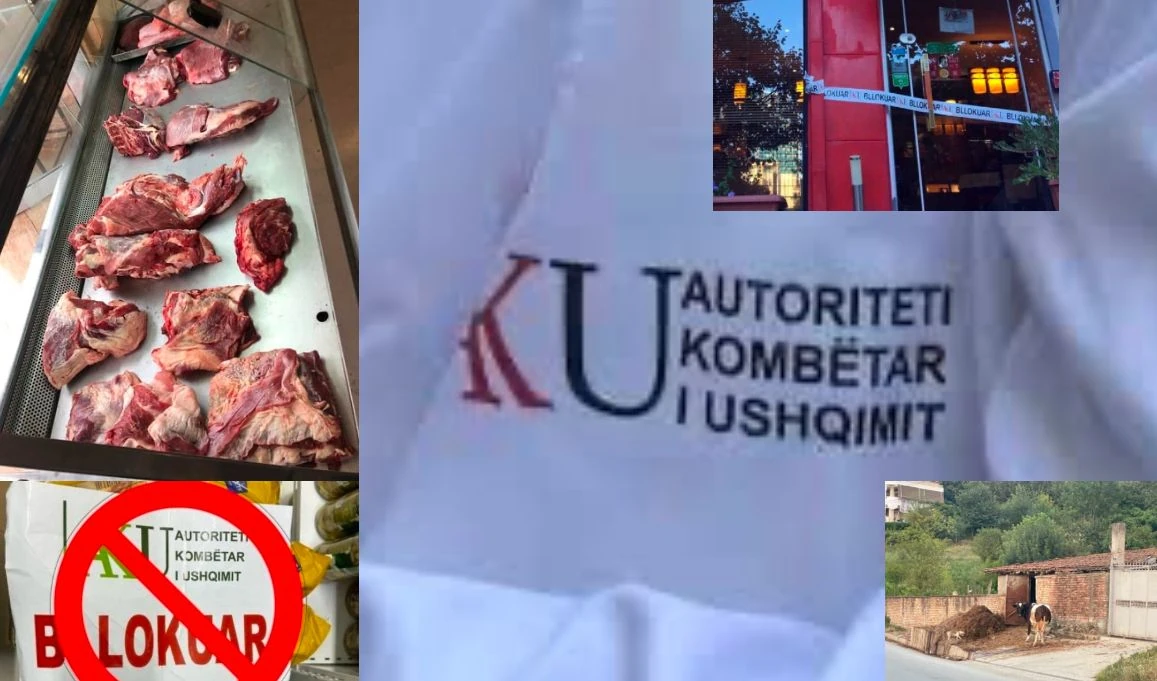
The most recent case in Shkodra, where the National Food Authority (AKU) seized 124 kg of unsafe meat and imposed fines totaling 600,000 lek on four entities, including the closure of two unregistered businesses, is indicative of a market that operates in complete violation of the law and without sensitivity towards the consumer.
Another scandal occurred in Gramsh, where about 70 children in a kindergarten were poisoned by Salmonella bacteria after consuming food provided by the company “Nelsa shpk”, an entity with a problematic history related to public tenders and hygiene and sanitation violations. Despite previous incidents and the lack of basic conditions such as functional refrigerators, this company continues to supply sensitive institutions such as kindergartens, nurseries and hospitals, while the contract with the Gramsh Municipality for children’s food is worth 100 million lek.
Food safety experts warn that lack of traceability, insufficient laboratory capacity and institutional impunity are deepening the crisis. Institutions like the AKU often react only after public denunciations, paving the way for manipulations, quality abuses and legal violations that directly endanger the health of citizens – especially children and the most vulnerable groups of the population.
Dangerous imports, an unstoppable practice
On June 21 and 22, 2025, the AKU in Shkodra blocked 124 kg of meat that was being traded without a veterinary certificate and without a control stamp. The meat, intended for human consumption, did not meet any legal standards. Four entities were fined a total of 600,000 lek, while two of them were found to be unregistered with the National Business Center (NBC).
“The subjects had neither documentation nor minimal hygiene conditions. The meat was without traceability and slaughtered outside any standard,” states the official announcement of the AKU.
This inspection was conducted as part of the monitoring of PPR disease in small ruminants, but it highlighted a meat market where violations are the rule, not the exception.
On May 20, 2025, 70 children from kindergarten no. 1 in Gramsh presented to the emergency room with symptoms of poisoning. Despite the parents’ complaints, it took five days for the case to become public. Investigations confirmed the presence of Salmonella bacteria in the food distributed by the company “Nelsa shpk”.
According to the NFA’s internal report, the kindergarten kitchen did not have a functional refrigerator for storing meat and dairy products – a worrying fact that had been noted previously.
Despite its problematic history, “Nelsa shpk” continues to win public tenders. The tender for the kindergarten food in Gramsh, worth 100 million lek, has been assessed by OpenProcurement Albania as a “red flag”, due to suspicions of abuse of public funds. Its ownership is linked to Elsa Kamberi (Balla), the daughter of a former official arrested for corruption in 2016.
Although the Ministry of Agriculture officially denies the presence of meat with ractopamine on the market – a substance banned in the EU – analyses conducted by ISUV show that imported meat is often contaminated. Albania imports tens of thousands of tons of meat every year, including from Brazil, a country banned in several neighboring countries such as Kosovo and North Macedonia for containing ractopamine.
In March 2025, the company AMG Food imported 27 tons of chicken fillets infected with Salmonella. The results of the tests were delayed for 10 days and the product was distributed to 154 points. The case, now under investigation by the Tirana Prosecutor’s Office, raises serious questions about the capacities and responsibility of institutions such as the AKU and ISUV.
Institutional failures

The institutions responsible for food safety are operating with limited capacity. From the lack of complete analyses and delays in issuing results, to the taking of samples under inappropriate conditions, the system is deeply problematic. AMG’s lawyer, Gentian Rumano, stated that the samples were taken at inappropriate temperatures, making the analyses invalid according to international standards.
Traceability of products is almost impossible due to the use of fictitious invoices. Although 2.6 billion lek have been pledged for food safety by 2025, laboratory analysis and sampling remain substandard.
To improve the situation, the government decided to merge the AKU, the National Veterinary and Plant Protection Authority, and the Aquaculture sector into a single inspection structure. However, the decision has not yet been implemented. On-site inspections remain ineffective.
According to the NFA, 30,000 inspections were carried out in 2024, but cases of abuse have not decreased. The EU’s RASFF system recorded 70 alert cases for Albania in the last five years, including pesticide products that were returned from countries such as Croatia.
Only ISUV and AKU have the capacity to conduct analyses on food samples, while ISUV has over 1900 EU-accredited tests. In 2024, more than 1000 samples were sent for analysis – 9% of them turned out to be inedible and with pesticides hazardous to health.
Experts, such as Ndoc Faslia, emphasize that institutional failure is also related to political interference and the lack of investment in specialized laboratories, which are essential for an efficient food control system.
Livestock crisis
The food security crisis is not only linked to problematic imports, but also to the decline of domestic livestock. In the last five years, the number of sheep and goats has been reduced by 40%, while that of cows by 35%. The high cost of production and the lack of subsidies have forced many farmers to give up this activity.
Expert Ndoc Faslia says that domestic production is not competitive and only 15% of farmers benefit from annual subsidy schemes. “The cost of production is 40% higher than in other countries, which makes it impossible to compete,” he says.
Albania finances three times less per hectare or per livestock head compared to countries in the region. Half of applications for support are rejected, leaving thousands of farmers out of the system.
The government has promised changes for 2025, including a budget of 400 million lek for subsidies. The scheme includes support of 5,000 lek for each calf, with the aim of encouraging livestock cooperatives.
But the data shows that only a small number of farms will benefit. Only 11% of farms have over 50 heads of livestock, while 36% have 1-5 heads. This means that the majority are small farms, unable to meet market demands.
“I have about 10 cows and a few calves. I applied for subsidies this year, but I’m still waiting,” says Maliqi, a resident of the village of Lapardha in Berat. He says the only income he expects is 5,000 lek per head, insufficient to keep his business afloat. “If I don’t get them this year, I’ll sell the ones I have and stop farming,” he concludes.

Praktikante-gazetare në “Rrjetin e Raportimit të Krimit të Organizuar dhe Korrupsionit në Shqipëri”- RRKOKSH.
Studente në fakultetin e historisë dhe filologjisë, Universiteti i Tiranës.