


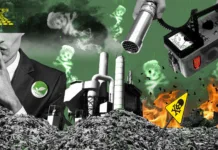







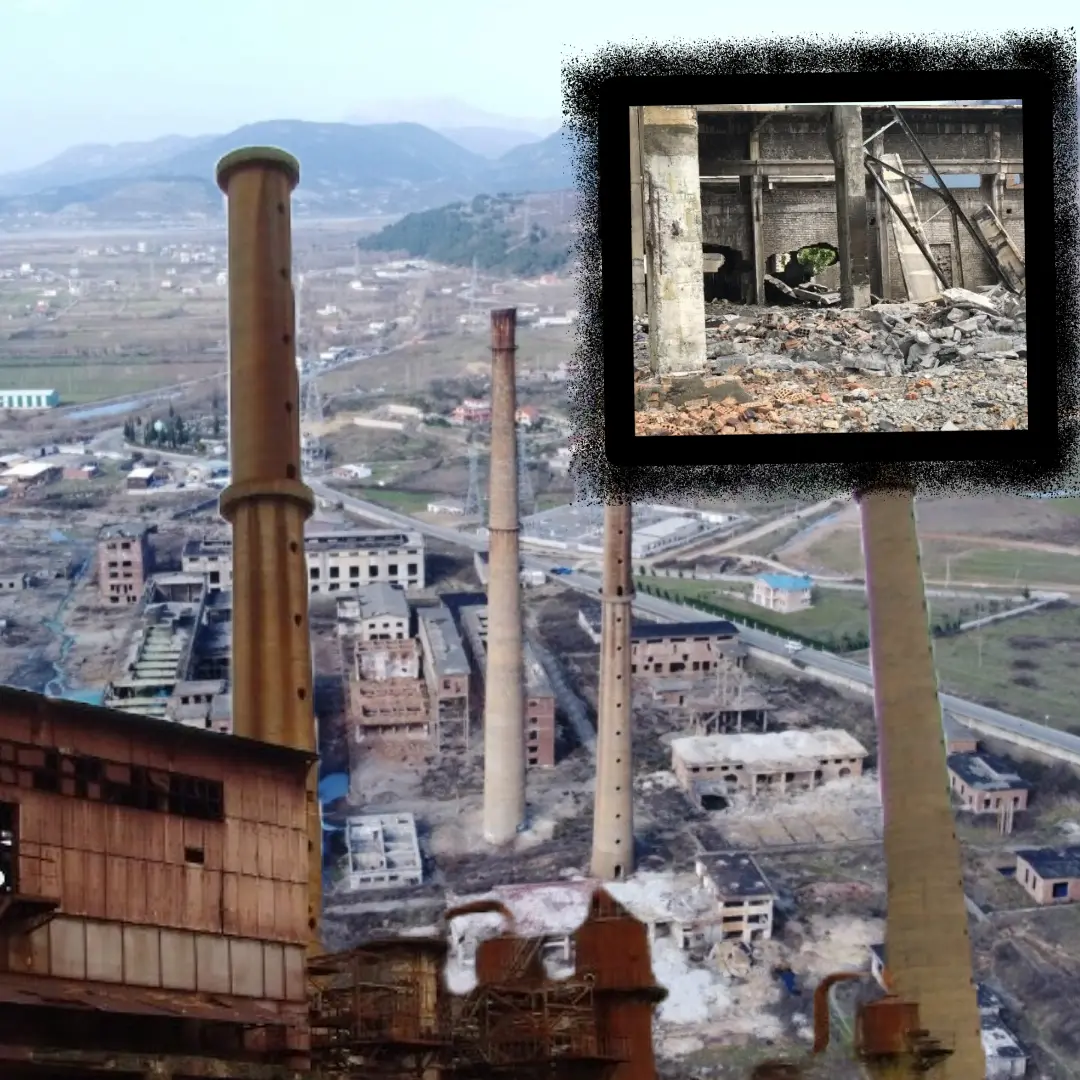
The former superphosphate plant in Laç, once the country’s industrial pride, today represents one of the problematic areas of environmental pollution and community health concerns.
Built in the 1960s, on an area of 380 thousand square meters, the plant has today been transformed into a building where 5 people have died over the last decade.
The ruins of the plant collapsed on their bodies as the victims were trying to make a living by collecting scrap metal.
According to official data, what is left of the former plant are thousands of tons of iron and considerable amounts of chemicals. So far, no one has taken care of installing protective layers and cleaning systems, even though national plans for waste management have been approved or agreements have been signed with foreign donors. Documents show that a fund of over 60 million euros has been allocated for the establishment of waste management structures, but “shteg.org” found no trace of the implementation of these projects, while the responsible institutions refused to explain where this money ended up.
The building that comes to life

On the outskirts of the city of Laç, as you pass through narrow alleys, you come across the 38-hectare area of land that once hummed with the industrial engine and workforce of the former Superphosphate Plant. Today, at its entrance there are car tires, a little further away piles of garbage, while to the right, chimneys and former administration buildings rise, almost collapsing. Going deeper, the eye sees strips of metal protruding from the walls of the buildings. Before the 1990s, these metals formed the structural basis of the buildings, while today they are a source of scrap for local residents. In the period 2004–2018 alone, five people have lost their lives from the collapse of walls while trying to collect scrap.
Inaugurated in 1967, this plant has become a toxic relic.
“The Laç complex has 60 kilograms of chemicals for laboratory use and 30 thousand tons of iron waste,” states the National Environmental Monitoring Program for 2025, published by the National Environment Agency. This waste has been deposited in the factory area without any protective layer or drainage system. The same problem was also mentioned in the Environmental Status Report for 2021.


A soil study in the area was conducted in 2000 by the United Nations Environment Programme (UNEP), which revealed the presence of arsenic and copper, substances hazardous to human health. Local residents claim that no intervention has been undertaken to improve the situation since then.
“I live near the plant and to this day, I have not seen anyone come to check or give us any solutions,” says Zef Ndreca, who has worked as an electrician at the plant for 15 years.
Local organizations such as the “Sebastia” Youth Center and environmental experts have called for intervention to rehabilitate the area.
“The idea is that deep rehabilitation is needed, because heavy metals and chemicals do not disappear on their own. The problem is not only the contaminated soil, but also the spread of pollution to groundwater from rainfall,” says biologist Eni Hoxha. She underlines that such pollution poses a major risk to community health.
The Youth Center has also included the community’s youth in the discussion about the future of the area. They have proposed that, after proper cleaning, the area be transformed into an attractive space for cultural and tourist activities.
“In our recommendations, we suggested turning the plant into a museum. The chimneys are very tall and stand out from afar. The idea of the young people was to paint them as new symbols of the city, or to use the premises for theater or film projects,” says Elsa Sula, an activist at the “Sebastia” Youth Center.
Millions of euros for strategy…


On May 27, 2020, the Council of Ministers approved the “Strategic Policy Document and National Plan for Integrated Waste Management 2020-2035”, with the aim of improving waste treatment and meeting the criteria for integration into the European Union. The document points out the lack of basic and complementary infrastructure for the treatment of hazardous waste. Also, until 2020, data on the quantity or types of this waste was missing.
Institutions such as the Ministry of Tourism and Environment, the Ministry of Infrastructure and Energy, the National Environment Agency, and local municipalities were tasked with implementing the document. But according to the annual monitoring report for the period 2020-2021, progress in the treatment of chemical waste has been negligible.
At the same time, the Albanian government signed a financing agreement with the German Bank KfW for a soft loan of 50 million euros and a grant of 11.9 million euros for the construction of waste management infrastructure. However, the National Environment Agency’s 2023 report notes that the current waste management system in Albania is insufficient and inefficient, and lacks financial and technical capacity.
“Albania does not have the capacity to treat hazardous waste,” says Olsi Nika, director of the “Eco Albania” center, but the government claims to have set up the appropriate infrastructure to treat it.
The same strategic document also envisaged the establishment of the Hazardous Chemicals Collection and Treatment Center in Elbasan, as a subordinate structure of the Ministry of Infrastructure and Energy. This center, established in 2015 by a decision of the Council of Ministers, aims to reduce the risk of environmental pollution from waste from former enterprises.
Located in the village of Balëz, the center is described as an arched building, covered in brick and lime, that preserves the industrial architecture of decades ago. A simple metal door leads to the interior where 13 employees work. According to the Ministry of Environment’s 2024 budget report, the center has had capital expenditures of 4.1 million lek for four projects, but no details were provided.


According to government documents, the institutions included in the strategic document are required to report to the National Environmental Agency every February 10th of each year. An online search did not find the reports completed by the Ministry of Environment, the Ministry of Environment and the specialized center.
Contacted by “shteg.org” to obtain information on specific reports for the Laç plant, center officials said they have not yet received confirmation from the Ministry of Infrastructure about the distribution of the data. The Ministry, on the other hand, has not responded by the time of publication of this article.
For months, various state institutions have been avoiding responsibility for the fate of the former factory in Laç, while citizens and organizations demanding transparency face silence or reciprocal addressing.
On the other hand, although the plant is located in the territory of the Kurbin Municipality, the latter denies any competence over it, transferring responsibility to the Ministry of Finance. However, this ministry, through a statement by councilor Elona Bedalli, stated that the facility is no longer under its jurisdiction, since the administration of such properties has been transferred to the Ministry of Economy.
This institution has also refused to provide clarification. Meanwhile, no one is answering what will happen to the considerable amount of chemicals with thousands of tons of iron that remain on the territory of the plant, waste that to date has documented the death of 5 people while thousands of others living in Laç are threatened.

Gazetare me përvojë në raportimin e kronikës së zezë dhe çështjeve politike në Shqipëri.
Gjithashtu, ajo ka qenë pjesë e “Investigative Journalism Lab” pranë “Albanian Center for Quality Journalism” (ACQJ).
Në SHBA ka marrë leksione të gazetarisë investigative në Kolegjin e Bostonit.
Desada ka përfunduar studimet në “Media Leadership and Management” dhe “Political Journalism” dhe ka qenë e angazhuar në projekte dhe internship-e që fokusohen në gazetarinë cilësore dhe hetimore.