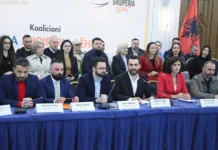

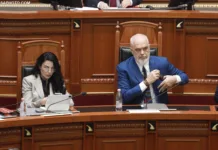
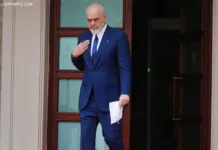
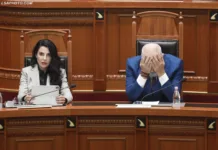

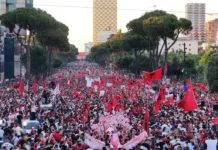
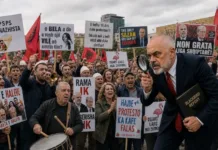
When the Central Election Commission officially announced the opening of the campaign for the 2025 parliamentary elections on April 11, Albanian citizens had already been familiar for months with the messages, promises, and faces that would seek their votes. Officially, a month for the campaign; practically, a year.
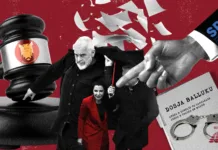
In the period from September 2024 to April 2025, 13 meetings were held in various countries in Europe and the US, where Prime Minister Edi Rama and his deputy Belinda Balluku appeared alongside Albanian supporters and communities, delivering speeches that contained clear calls for votes, although often camouflaged as commitments “for the future Albania.”
From Athens to Milan, London and New York, these meetings have been accompanied by professionally produced footage, massively distributed on social networks, exceeding the limits of institutional communication.
Despite the fact that the Electoral Code stipulates a month of campaigning until the election date, observations conducted by “shteg.org” show that the campaign for political groups has started earlier, violating several articles of the Electoral Code.
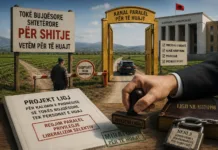
One of the violated articles is that of number 84, which prohibits public institutions from advertising, except in cases when they are related to raising voter awareness about the electoral process. However, despite this legal restriction, the Socialist Party has used the small screen of mobile phones to distribute videos of works that are still in the development phase.
Election campaign year


In a packed hall in Athens, on May 12, 2024, Edi Rama held what would be considered the silent start of the Socialists’ electoral campaign. In the presence of over 5,000 Albanian immigrants, the prime minister did not yet talk about elections, but about “reconnecting with the roots” and “the contribution of the diaspora to the development of Albania.”
But amid the applause and red and black flags, the political message was clear. “There is no strong Albania without an organized diaspora. The Albania of 2030 will be a country of free choice,” Rama said, in what many saw as a coded electoral speech.
This was the first of nine meetings with the Albanian diaspora that Rama would hold over a one-year period.
According to observations by “shteg.org”, Prime Minister Edi Rama has participated in nine different meetings with Albanian immigrants in Greece, Italy and the USA.
Just two weeks after the Athens rally, on May 26, the destination was Milan. This time, among young Albanian engineers and entrepreneurs in Italy, Rama spoke openly about brain drain and new opportunities in the country. “I’m not asking you to come to vote, I’m asking you to come to build,” he said, in an appeal that transcended politics.
“It has died once and for all, just as any chance that the shadows of the past will return on horseback to saddle Albania’s European destiny in an unknown direction has died once and for all,” Rama said.
In the months that followed, the prime minister continued to hold meetings in the United States, including a major event in New York in October.
Asked what Albanians in America can do to contribute, he replied: “They must become guarantors with their participation in the elections. They must become guarantors that Albania does not go backwards.”
In his rallies, Rama has given the clear message that building an untainted justice system where no one is untouchable is the reason why the Socialist Party should be voted for a fourth term.
In addition to meetings of a political nature, on March 2, 2025, Rama participated in the Job Fair in Thessaloniki.
Under the slogan “Work and live where your heart is,” he promoted employment opportunities in Albania and wage increases. In a symbolic moment, as a glass breaking could be heard in the background, he interpreted it as “the fall of the owl’s eye,” an ironic reference to former Prime Minister Berisha.
“This is how the eye of the tawny owl will fall to the ground. But I’m not talking about May 11, because we didn’t come here to campaign.”
From posts on social networks, it appears that the Prime Minister was present at over 30 electoral meetings across the country during April and May 2025.
However, he was not the only representative of the left who held numerous meetings of an electoral nature.
Followed by Balluku

While Rama appeared in international metropolises, Belinda Balluku chose to launch the campaign from her base, the Fier district.
She began meetings on October 5, 2024, and by the end of the campaign, she had held a full 80 meetings in this district.
In her first visits, Balluku preferred more intimate formats. Family meetings, visits to companies or even with public administration employees. Out of 49 pre-election meetings, she went to 9 in the homes of rural and urban families and 27 in private enterprises.
“I don’t come here to ask for votes, but to hear your voice,” she would say on November 17 at a meeting with garment workers in Patos.
But Balluku did not limit herself to Fier. She held 4 meetings with the Albanian diaspora, one in London, twice in Athens and in Milan.
At these gatherings, Balluku spoke about the government’s challenges, but also the ambition to return Albanians to the country.
“I don’t want to speak to you as a minister, but as someone who comes from a family of immigrants,” Balluku said in London, in an emotional speech that was widely shared on social media.
When the campaign formally received the green light on April 12, 2025, Balluku intensified his activity in Fier. 31 meetings within 25 days, from meetings in administrative units to rallies with dozens of supporters, turned him into one of the most vocal voices of the campaign.
“This is not just a campaign for votes, but for trust. If you turn your back on those who work, we will turn the country backwards.” – she declared in Roskovec, while in Lezha, Minister Balluku appeared near the works for a road segment.
“The works speak for themselves and these are not promises, but projects in progress,” declared Balluku.
Although the meeting was not called a rally, dozens of citizens, local leaders, and SP figures were present, while published footage showed the distribution of informational materials with the government logo and a slogan: “Work does not stop” – a phrase that has been reused in almost every electoral meeting in May.
On the campaign every day of the year


The Electoral Code, in Article 84, clearly prohibits the use of public funds and promises for unfinished projects during the campaign. But the activities of Balluk and the government cabinet show another reality.
In 27 of the documented meetings, Balluku has appeared in public centers such as hospitals, schools and senior centers, where she has made statements about investments in infrastructure, improved services and new promises. She has spoken about the Great Ring Road project, urban requalifications, subsidies for farmers, and incentives for businesses, all disguised as government engagements, but distributed through her personal channels on social networks.
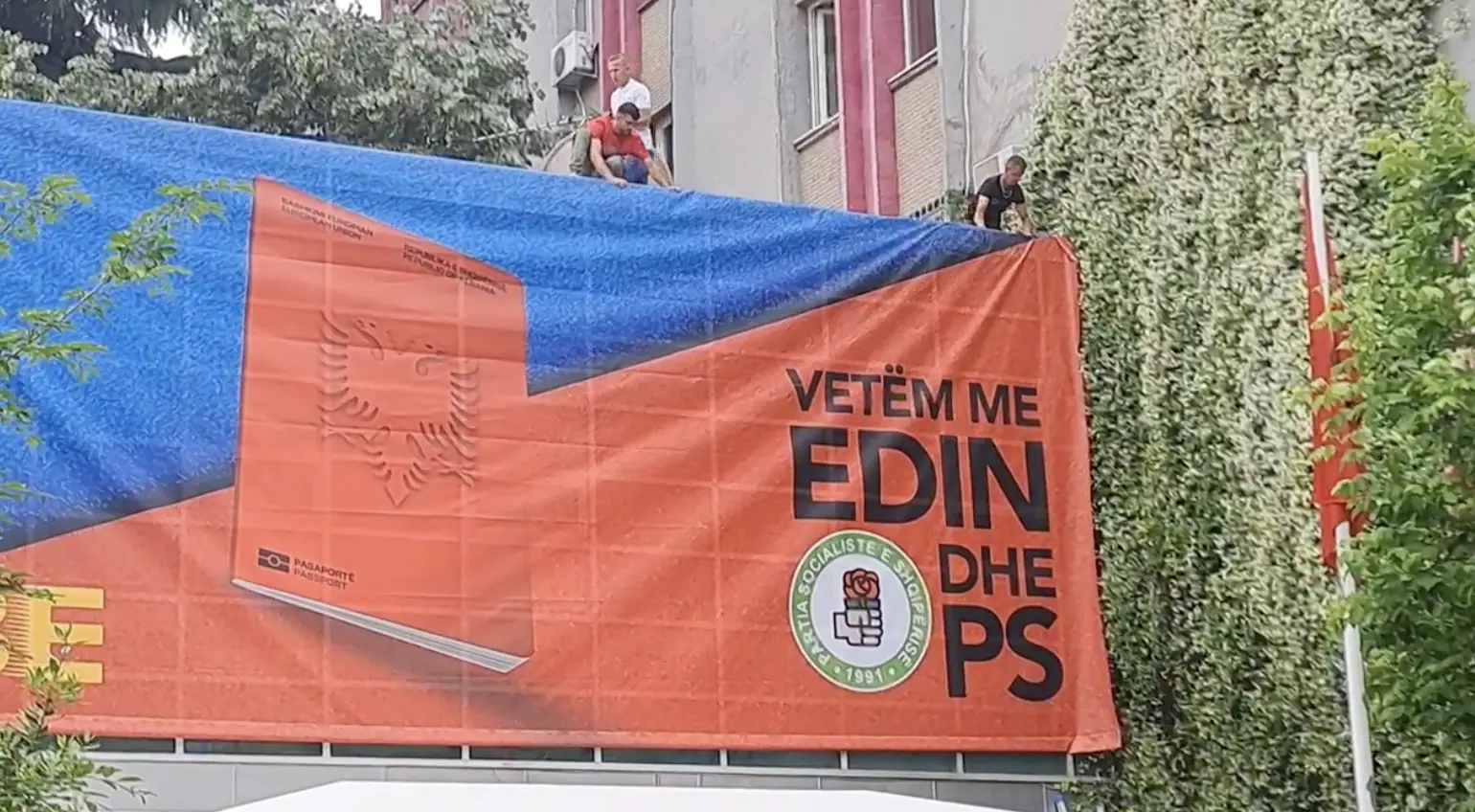
In each post, in addition to informative content, the use of slogans such as “Albania 2030”, “Only forward” is noted, and the Albanian or EU flag often appears, symbols that give the communication a weight of collective and Euro-integration identity, but also create an image that reinforces the propaganda of victory.
Fearing the return of the past was an approach often used in Prime Minister Rama’s rhetoric.
In every public appearance, he has spoken of the “risk of going backwards” as a political threat to citizens, linking the Socialist Party’s victory to “the continuation of justice reform”, “economic security”, and “the protection of the democratic order”, statements that contradict the Electoral Code, according to which no public entity can engage in the promotion of government activity in order to influence voters during the campaign.


Public relations and election monitoring experts consider this behavior a systematic violation of democratic standards, where the boundary between governance and campaigning has disappeared.
In their analysis, they emphasize that we are dealing with a “permanent campaign” that uses the public administration as a promotional machine, while the opposition does not have equal access to the public or the media.
But what set this year’s campaign apart, according to Jonila Godole, director of the Institute for Democracy, Media and Culture, was artificial intelligence and podcasting as a new format for political communication.
“The novelty of these elections was neither the political programs nor the mass rallies, but the application of artificial intelligence and podcasts as a new format for political communication on social networks,” says Godole.
But despite this technological transformation, what worries the political communication professor was the lack of real debate.
“I regret that there was no substantive debate on the ideological values and vision that the parties have for Albania and Albanian society,” says Godole, according to whom the television appearances continued by inertia, without producing any measurable effect.
“The debate shows did not produce any new format that focused on the confrontation of voters with the candidates for parliament, but continued with the old schemes, where politicians are the ones who decide which analysts and moderators they will face.”
Against this backdrop, a fundamental question arises: did the new political forces have a real chance of competing?
In a campaign dominated by the two major political forces, these new forces were left on the periphery of public attention.
“While the two major parties were dealing with each other with jokes and accusations, the new political forces had a good chance to unveil their programs on social media, which they did, although not completely. Two new parties like “Bashke” and “Mundësia” tried harder to profile themselves by addressing sensitive topics for citizens, such as pensions, minimum wages, fiscal policies or the reduction of state administration. Although the media and digital dominance of the main parties left the new forces somewhat on the periphery, I think this year’s elections mark the end of the long political transition where only two main parties dominated without ideological differences between them. The future will belong to coalitions and a pluralistic government with more than one party.” – says Jonila Godole.

Dallandyshe Xhaferri është gazetare në "Rrjetin e Raportimit të Krimit të Organizuar dhe Korrupsionit në Shqipëri" - RRKOKSH. Ajo ka studiuar Gazetari në Universitetin “Aleksandër Xhuvani” dhe ka marrë pjesë në shkëmbime studentore në Poloni dhe SHBA. Në Poloni, ka ndjekur një semestër në "Journalism and Management" në Universitetin "Papa Gjon Pali II", ndërsa në SHBA ka marrë leksione mbi gazetarinë në Kolegjin e Bostonit. Gjatë katër viteve të fundit, ajo ka punuar si gazetare në organizata të ndryshme me fokus gazetarinë cilësore dhe ka qenë e angazhuar në projekte të IFES, East West Management Institute dhe Rana Labs.