




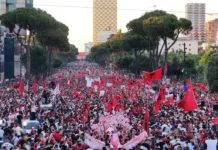
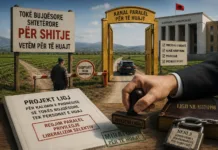
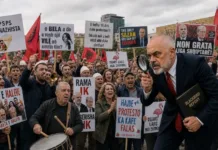
When you enter Shkodra this spring, the first feeling is not that of a city on the eve of elections. The campaign is not loud, it does not explode with rallies, it does not deafen you with loudspeakers. It is restrained, almost under the voice, but it “howls” door to door.
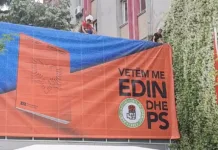
The billboards, however, are there. At the entrance to the city, flags and posters placed on metal fences, buildings and even institutions bear witness to the battle for the city.
“Salaries like in Germany, prices like in Tirana”, “We are with you”, or “It is haram to sell your vote”.
As the Democratic Party continues to face its internal crisis and an increasingly demoralized base, the Socialist Party candidates, quietly supported by Benet Beci, who is consolidating institutional control of the municipality more and more every day, have more chances of victory.
It seems that the battle of the two political forces is with the Social Democratic Party, which has built a silent but effective network of influence that functions beyond public rhetoric. Instead of rallies, there are aid distributions; instead of political promises, there are concrete interventions in the personal problems of citizens.
On the eve of the elections


It’s 8 a.m. on April 9th, and on the highway that sends travelers to the capital of the North, Shkodra, it seems that only political posters that dictate who voters should vote for welcome them.
At the entrance to the city, very close to the Faculty of Nursing building, it is written in large letters.
“12 years of prices like in Germany, salaries like in Africa” while a few meters away from the DP poster is the poster of a candidate for MP, who in the Gheg dialect calls on citizens to choose the right representative to raise their voice.
Meanwhile, in the “Abu Bakr” mosque, in large letters, it is written: “It is haram to sell votes.” It is carefully placed to attract the attention of passersby, where some stop, some laugh, some raise their eyebrows, and others walk on as if nothing is there.
The entire entrance to the city looks like an exhibition of colors, slogans, and figures competing for a little attention.
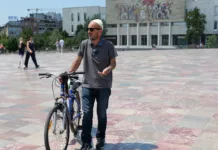
In the city, the atmosphere seems calm, with citizens enjoying their morning coffee or spending time in parks, while political conversations are present in daily discussions.
A retired former teacher, who has no faith in any political party, expresses his dissatisfaction with politicians, saying that they all lie.
“I don’t vote, I don’t trust anyone. Today I read that they haven’t removed Berisha’s non-wife. They’re lying, so am I,” says the retired teacher.
However, opinions are divided among citizens.
On the other hand, Robert, a young man from Vau i Dejës, enthusiastically says that he supports the Chairman of the Social Democratic Party, Tom Doshi.
He is convinced that Doshi’s image has been distorted by the media and that the latter is a great benefactor to the community but also to him.
Roberti says that the PSD Chairman has sent a child of his acquaintance diagnosed with acute leukemia to Italy for treatment.
“He brought it with his own money and didn’t ask for anything,” says the young man, without forgetting to add his influence in Vaut i Dejës.
“He has recruited many young people from the area and employed them in his businesses in Tirana,” he continues, emphasizing that, despite his good deeds, the greatest benefactor has not asked anyone for their votes.
Rumors of such aid circulate all over the city. It’s not hard to find people talking about “free lunches,” “aid for medicine,” “fuel for the sick,” or “jobs for the son.”
Tom Doshi’s name is mentioned naturally, as if he were a figure who does not belong only to politics, but to an institution in his own right. Many of them no longer identify him with the Social Democratic Party, but with a specific format of support.
Shkodra is an area in which Doshi has had a large number of supporters for years.
During the 2017 parliamentary elections, his party emerged as the third strongest in Shkodra, although Doshi had not yet been informed of the Court’s decision as he was accused of the criminal offenses: “False report”, “False statement before the Prosecutor” and “Threat for false statements or testimony, expertise or translation”.
The PSD played an important role with its influence on the electorate in winning the Shkodra Municipality from the Socialists, who had Benet Beci as their candidate.
According to the executive director of the Institute of Political Studies, Afrim Krasniqi, if Albania had laws regulating parties, the PSD would no longer exist.
“If you open the PSD website, there is no data on the leadership and decision-making structures, or any notice of meetings where decisions are discussed and made. Doshi is the chairman of the PSD, he is a businessman, he is the owner of the party and he has a personalized list provided through his acquaintances,” says Krasniqi, while on the eve of the elections, unlike a month ago where on the official PSD website readers were introduced to some of the candidates and Doshi’s meetings, currently everything has been deleted except for the PSD’s promises in case it wins the elections.
Its program is reflected in a short paragraph for each economic sector, without clarifying how they will be implemented.


The PSD headquarters in Shkodra is located on a little-known alley. A simple building, with a faded plastic sign, where the party’s name is written. The gate is closed, but after a knock, it is opened by an employee. “There is no one here. Everyone is in Tirana,” she says, without saying much.
A little further away, near the city center, the Socialist Party headquarters is more organized, but still quiet. A local official admits that most of the leaders are also in Tirana.
At the Democratic Party office, a young man is the only person in the building. He explains that the activity takes place in the field, “we are not very active here.”
Elections, it seems, no longer happen in offices or political forums, but in cafes, on the streets, and in clientelistic networks.
Between the image of charity and suspicions of vote buying

In Shkodra, one of the largest and most important districts in the north of the country for the elections of May 11, 2025, politics is not just a competition. It is part of everyday life, often invisible, intertwined with economic aid, healthcare, paid coffees, and memorable honors.
In the absence of open offices and grand rallies, the campaign happens in silence, on a doorstep, in a phone call, in a lunch, in a debt that is not repaid, but is remembered when voting day comes.
For years, Tom Doshi has been identified in Shkodër and especially in Malësia e Madhe with charitable activities. Economic aid for families in need, support for the sick and social actions that have strengthened his perception as a “helper of the people”. This image has served Doshi to build a stable electoral base.
However, recently, this image has been put under serious pressure by a series of investigations launched by the Special Prosecution Office (SPAK), which suggest another reality behind the facade of charity.
Ardian Hysa, PSD chairman for Malësia e Madhe, is suspected of being part of a scheme to buy votes and collect identity cards, with the aim of influencing the outcome of the May 11, 2025 elections.
The wiretaps obtained by SPAK document conversations where Hysa offers economic aid in exchange for votes, as well as communications discussing the collection of ID cards, a suspected tactic to prevent citizens from voting.
The Special Court has authorized searches of him and his suspected accomplices, seizing equipment and documents that could serve as evidence in the investigation.
According to SPAK, Ardian Hysa is suspected of being active in the campaign by offering money for votes. It is suspected that the amounts were received from other PSD representatives operating in the Shkodra region.
SPAK’s official wiretaps document a conversation between Hysa and citizen Florenc Tonin Kalaj, who asks for help in exchange for his vote and that of his family.
“For God’s sake, now that I know, there are few votes and a man as they say, I have those who are my people, you understand? But for God’s sake, I have a hard time getting out of the problem I have, you understand?… But I don’t know if anything happens, as they say, I can get that letter…” – the file says.
From the content of these communications, according to the Special Prosecution Office – “there is a reasonable belief that citizen Ardian Hysa, in collaboration with other yet unidentified citizens, are involved in illegal activities in the field of elections and specifically, in addition to giving or promising illegal benefits in exchange for votes, they have also engaged in taking identity cards of various citizens, in order for the latter not to participate in the elections of May 11, 2025”.
According to the file, this evidence has convinced the prosecution that Ardian Hysa, in collaboration with others, was not only promising benefits in exchange for votes, but was also engaging in a scheme to collect identity cards so that citizens could not vote on May 11, 2025. Based on this, the Special Court ordered a personal search of Ardian Hysa, a search of his apartment, business and vehicle (a service station and a Mercedes E300, 1991) and a personal search and home search of Florenc Tonin Kalaj, with the aim of seizing mobile phones, documents, ID cards and any material that could serve as evidence in the investigation.
The decision states that “The conviction is created that Ardian Hysa promises irregular benefits to various citizens, demanding in return votes for a certain political entity.”
The PSD, on the other hand, has denied involvement in any illegal actions, insisting that no incriminating material was found during the checks and describing the investigation as a political attack.
She emphasizes that there is no concrete evidence related to the structure of the party as an organization.
Meanwhile, the General Prosecutor’s Office has announced that 54 reports of electoral crimes have been registered nationally so far, of which a significant portion pertain to politically sensitive areas such as Tirana, Elbasan and Shkodra.
As the vote approaches, Shkodra remains a key battleground, where the race for seats has intensified, under the shadow of criminal investigations and heightened political tensions.
CEAZ No. 02, which covers 106 voting centers with around 71 thousand voters, the battle is taking place for 11 parliamentary mandates.
In the past elections, the Socialist Party received 3 mandates, while the Democratic Party received 5 mandates and the SMI received 1 mandate, belonging to Agron Çela who later switched to the Socialist Party.
This year, the race is even fiercer. Both the Socialist Party and the Social Democratic Party are seeking to take advantage of the split in the Democratic Party to win one more mandate than in the 2021 elections.

Dallandyshe Xhaferri është gazetare në "Rrjetin e Raportimit të Krimit të Organizuar dhe Korrupsionit në Shqipëri" - RRKOKSH. Ajo ka studiuar Gazetari në Universitetin “Aleksandër Xhuvani” dhe ka marrë pjesë në shkëmbime studentore në Poloni dhe SHBA. Në Poloni, ka ndjekur një semestër në "Journalism and Management" në Universitetin "Papa Gjon Pali II", ndërsa në SHBA ka marrë leksione mbi gazetarinë në Kolegjin e Bostonit. Gjatë katër viteve të fundit, ajo ka punuar si gazetare në organizata të ndryshme me fokus gazetarinë cilësore dhe ka qenë e angazhuar në projekte të IFES, East West Management Institute dhe Rana Labs.