



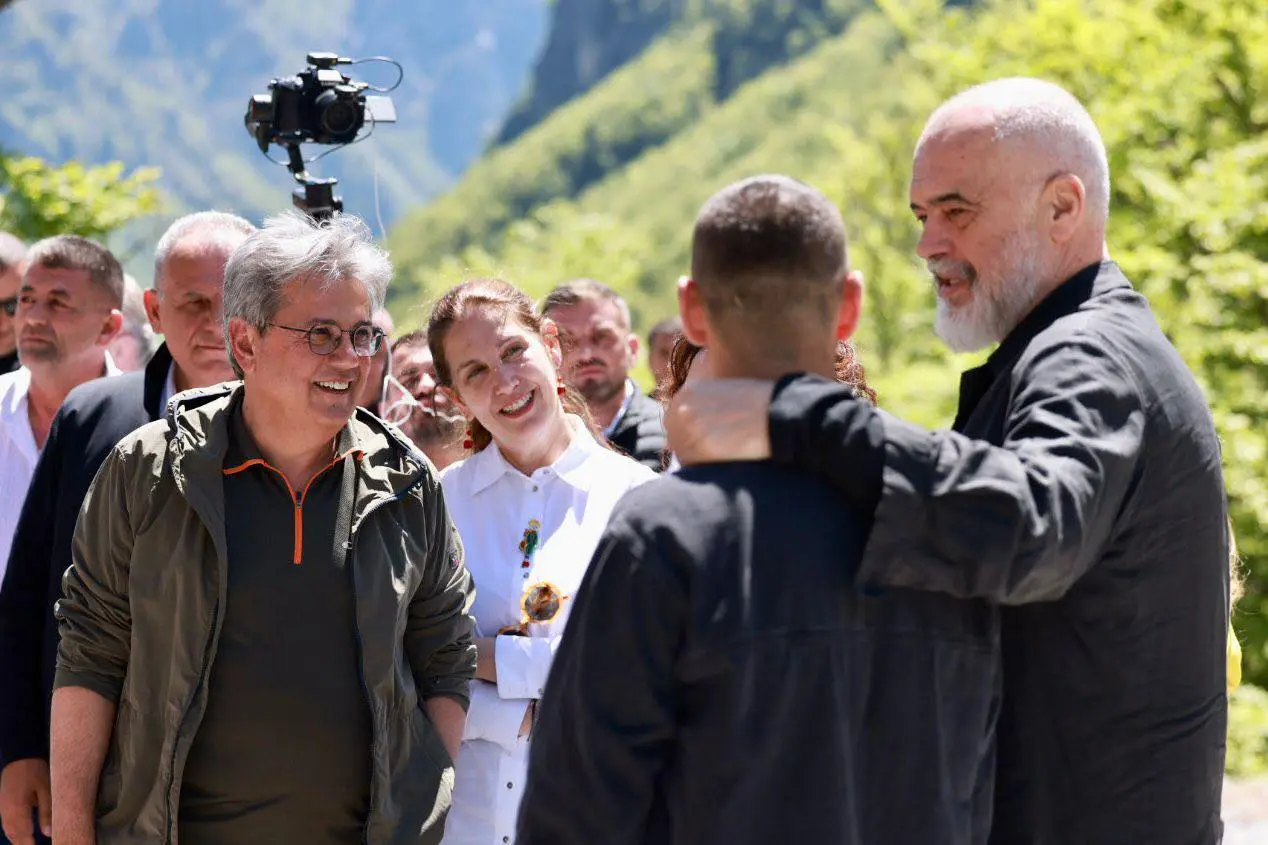
“Welcome! It’s good that God brought you! Bread, salt and heart!”. This is how Prime Minister Edi Rama was welcomed a year ago in Theth, by a local girl dressed in traditional costume, who handed him a piece of bread baked by the hands of local women. The Prime Minister broke the piece, dipped it in salt, and tasted it amidst folkloric ovations and çifteli dancers, in a scene that resembled more a national celebration than a business meeting.
Accompanied by the Mayor of Shkodra and the Minister of Tourism, Prime Minister Rama returned to Theth to tell the locals that he was a trustworthy man, who would not only distribute the land titles but also forgive the numerous fines for illegal construction.
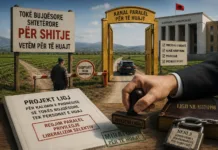
A month ago, when he visited Thethi to talk about the “Mountains Package”, Rama had promised property certificates for many families whose property the state did not recognize, a problem that had paralyzed investments and hindered tourism.
200 property certificates for the families of the area were prepared by the local administration, while Rama personally gave one of them to the Thethians in June 2024.
“On June 30, we promised to return and here we are today, at the end of the month, to distribute property titles… a work that has been underway for a long time, which is now in its final stages. What we are doing here, we will also do in other areas, both in the north and in the south,” he told the residents, explaining the legal obstacles that prevented the mortgage of their buildings.
“Today there are 200 property titles. Meanwhile, there are 90 others that will be distributed,” he said, while implying that there was another group of 50 files that still could not be legalized due to construction outside the legal deadlines.
But even for this, Rama had a promise.
“We will find a dedicated solution for all those in your situation, where the inability to obtain a construction permit has been objective. Constructions made due to your need to build an economy through tourism, not because you did not want to build according to the law but because the tightening of legislation for this area, legally a protected area, has made it impossible, and the government will forgive all those fines, because they are not constructions made abusively to evade the law.” – the prime minister continued his promises, adding that even the fines imposed by authorities for construction without a permit would be forgiven by his administration.
Instead of talking about law enforcement, Rama chose to justify constructions made by locals.
“These are fines imposed for constructions that were not made to evade the law, but out of necessity. These are not abuses, but constructions carried out in the impossibility of implementing legislation. All fines will be forgiven,” he said, touching on the sensitivity of all residents who had sacrificed to invest in the land of their ancestors.
The prime minister’s entire speech at that meeting was a public guarantee: that the residents’ efforts to restore life in Theth would be supported, not punished. He promised the return of young people from emigration, the rescue of property, a flourishing tourism, and a facilitating climate for investments.
“It will be a top-class destination. You will pay a lot to sleep here for a night,” Rama said.
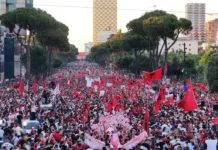
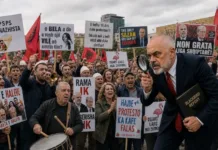
But in mid-July 2025, instead of singing, the sound of the fadromas is heard in Theth. Instead of the çifteliva, the screams of the protesters. Instead of hugs, clashes with the police .
Instead of ownership certificates, bulldozers


A year after the sensational promises and the dance party in Thethi square, residents have faced not support, but violent state intervention.
Instead of legalization papers, on the road leading to the mountains, IKMT vehicles have been seen, accompanied by police. Where a year ago there was talk of “forgiveness of fines”, today demolition orders have been issued.
Houses, guesthouses, and tourist structures that residents had built with loans, aid from immigrants, or years of hard work have today been declared “illegal.”
According to the Mayor of Shkodra, Benet Beci, the constructions are in a protected area, without permission, and after legal deadlines.
“The center of Theth is returning as the true heart of the Albanian Alps! 4 work groups, 20 employees, 60 truck routes and 7 road sweepers of the Shkodra Municipality have removed about 500 m³ of concrete from the historic center of Theth. A major intervention to systematize, clean and restore this gem to its former splendor” – writes the mayor.
But in dozens of television reports, residents say they built on their land, inherited from generation to generation. That the entire area has never had an approved development plan, and that it has not been possible to obtain permits.
“He promised us he would solve it. Today, he brought us the fadromat as a solution,” says a resident who is trying to save the walls of the hostel he had rebuilt with the help of his son from England.
According to information from the field, at least 150 objects are on the IKMT verification list, while some have been ordered for demolition.
From a symbol of development to an “illegal criminal”

A video from the center of Theth near the Kulla e Ngujimit showing several huts built on concrete announced the launch of an action to demolish unauthorized buildings in the village.
Those who a year ago the Prime Minister told them to build, today he calls “criminals who have thrown the concrete of the world.”
“This is the wonderful field of Theth, where a criminal, who does not even have the courage to appear while IKMT is enforcing the law, has poured the world’s concrete to build his “tourist village” without any permit, a multiple crime,” Rama wrote, which also started a debate with Shkodra prosecutor Elsa Gjeli , who had refused to initiate criminal proceedings for these constructions.
He publicly criticized the Shkodra Prosecutor’s Office for not pursuing the cases and defended the IKMT’s action as a legal obligation. “This is the wonderful field of Theth… a mess is being made,” Rama said.
Immediately after this incident, the massive IKMT action began. At the height of the summer season, the Fadromas, accompanied by police forces, descended on the village to demolish about 80 or 90 tourist investments built without permits.
The FNSH forces approached the village to observe from a distance, awaiting an order, while the residents blocked the connecting bridge at the entrance to the village to prevent the raiders, clashing with the police.
The leader of the IKMT action, one of the most senior officials there, Fatmir Meta, told reporters that the order is for the demolition of 70 or 80 unauthorized buildings.
“Absolutely, illegal buildings. Illegal buildings will be demolished, about 70 or 80 illegal buildings. We do not interpret the law, we implement the law. We have given prior notice for days, we were promised that they would be dismantled. This is the third day that we have come to the Lord and ordered. These are new buildings. I am not clear about the constructions when they were erected. A mess is being made, a place a miracle by building kiosks instead of protecting this area, this miracle of God, instead of protecting it, building with criteria and the residents themselves should be there to protect it, not to bastardize it,” declared Meta.
But residents see the situation differently.

First, they don’t understand why the state is asking them to destroy their investments at the height of the season, when some tourists have been forced to cancel their vacations, while others watch in amazement as dozens of police officers surround Thethi’s guesthouses as if they were a crime scene.
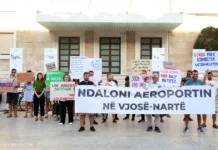
“We wanted to make a call for a common solution. But not in the middle of the season to carry out a massacre,” one of the protesters told the police who were trying to enter the village.
Meanwhile, in the protest filmed by dozens of cameras, a protester says it is his right to protect his property.
“This one is right because he gives orders to that other one, but we also have the right to protect our property! By God, I’m here last night when I saw that collapse of the inns there!”
“Open the road means they will demolish my house,” said another, “But where will I stay when you demolish our house? I will stay on the road, in the rain. I am still in the rain. You are pushing us by force. You are destroying our houses,” said another resident of the area with both voice and image.
As they see the hostels and the police surrounding their homes, others remember that it was the same police and inspectors who took bribes when these hostels were built without permission from the state.
One of them directly accused the police chief during the protest and as a result, the police attempted to arrest him, but without success.
“You have taken a bribe to demolish these buildings! You! You are the thieves! You are the thieves! Today you come and demolish them! You are the first! (Police: Report to the prosecutor’s office!) You are the first to come here and demolish them! Do you enforce the law? You have taken a bribe and you have left them to be built!
Meanwhile, another elderly protester recalled how Prime Minister Edi Rama had promised them that they could invest their money and bring their children back from abroad to live in Theth.
“When Edi Rama came here to Theth, the Prime Minister of Albania openly said, everyone build on your properties. Now where did this idea come from? The youth came back from abroad. I have never left, I am a permanent resident. I will set fire to it. It is better for them to take my soul than to do what they have done. I cried like a child yesterday when the house of someone who is drowning in debt collapsed. I know that you have a duty to the state, they give you orders, but we will also protect our wealth and sweat” – said one of the residents of Theth.

Lindita Çela është një gazetare investigative e shquar, e njohur për raportimet e saj të përpikta dhe të guximshme mbi krimin e organizuar dhe korrupsionin në Shqipëri. Me një karrierë që shtrihet për mbi dy dekada, Çela është konsoliduar si një figurë e rëndësishme në fushën e gazetarisë investigative, duke fituar vlerësime si në nivel kombëtar ashtu edhe ndërkombëtar për punën e saj.