








It was a mild gray winter with a lot of rain. Here and there a yellow flower poked its head out into the beautiful forest of Butrint. The rain that poured down like a river on the old walls of the Venetian Tower had a gentle rhythm like the defi of the desert Bedouins. Summer was left behind. Nothing moved anymore in ancient Butrint, soaked by winter rain.
The British School of Rome excavations had been interesting this summer as well. In Butrint we had some new discoveries, but the discovery of some Roman coins had intrigued me a lot. In a way these coins had brought back to our attention a very important event for Ancient Butrint: the fate of the Roman colony that was established in the city after a fierce battle in the Roman Senate. The gray winter, the silence of the forest or the fact that I was standing on the ancient ruins made me browse more on the fate of the Roman Colony known as Colonia Augusta.
During the Civil War between Caesar and Pompey, a Roman legion loyal to Caesar was stationed in Butrint. After his triumph at the Battle of Pharsalus, where Caesar remained the sole victor on the battlefield, and his triumphal entry into Rome, he, among other things, began a reform of the distribution of lands to his veterans. Perhaps recognizing Butrint when he marched along the Vjosa in pursuit of Pompey, Caesar decided to send his legionaries to this city, once founded by the fled Trojans. But this decision was fiercely opposed by the local inhabitants, who gathered around an important Roman figure, Titius Pomponus Atticus.
Atticus, an aristocratic Roman banker, spent most of his time at his villa in Butrint. Named Amalthea, in memory of the goat that had suckled the great Zeus, the villa was surrounded by books, statues, and educated slaves. Atticus hosted his friends from Rome in this villa. Among his closest friends was his close friend Senator Cicero, for whom he had published his speeches in the Senate. Atticus is also known as the first “publisher” in Roman history. Cicero, who had spent a long time at the Attic villa in Butrint, used his influence to prevent the arrival of legionaries in Butrint.
There are about 40 letters between Cicero and Atticus, where Butrint is at the center of attention of these important figures of the time. With strong lobbying by Cicero in the Roman Senate, it seemed that the danger had passed.
Caesar promised that his legionaries would not settle on the lands of Butrint, although according to Cicero this decision was also aided by a gift from the Buthrotai/Atticus to Caesar on the eve of his electoral campaign. The Dictator’s promise remained in limbo in the hands of the Senate after his assassination on the Ides of March. The consuls elected after this historic event were Mark Antony and Publius Cornelius Dolabella, who had more complicated issues to resolve than the Buthrotai’s complaint about their lands. Despite the efforts of Atticus and Cicero, the ships of the colonists arrived at Butrint, under the leadership of the Praetor Munatius Plancus.
But the colonists were received quite harshly by the local population and in a letter of Cicero we learn that “Consul Dolabella had placed the fate of Butrint in a secure position” meaning that the colonists would not settle in Butrint. But fate changed the favorable winds of Butrint coming from Rome. Events flowed with frightening speed and during the civil strife of Mark Antony and the senators Cicero was brutally murdered in his Italian villa.

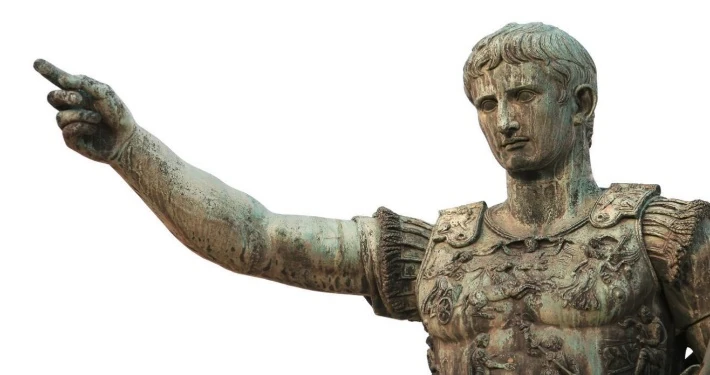
Agrippa disappears from the scene, dies in his villa in Rome, and from the ashes of civil strife emerge two dominant figures on the Roman scene. Octavian Augustus, Caesar’s adopted son, and his loyal friend and general Marcus Vipsanus Agrippa. Octavian and Agrippa had met at the school of Oratory in Apollonia Illyricum, and from there they marched together towards triumph and history. But Butrint had a historic fate this time too. The first general of Rome and the winner of the battle of Nicopolis against Cleopatra and Mark Antony was the son-in-law of Butrotas. He had for wife the daughter of Atticus, Caecilia Attica, the greatest protector of Butrint. Together they had a daughter (who married the future Emperor Tiberius). Supported by Agrippa and without any opposition from the former patrons of Butrint, now gone from the stage of history, the recolonization of the city was carried out rapidly. Agrippa, the number two of what would now be known as the Roman Empire, decided to found the Colony of Butrint with VETERANS, the legionaries of his loyal Legion, Legio V Macedonicus. It was these veterans who, together with their families, arrived in Butrint, just as 1,000 years earlier when the homelandless Trojans founded this city as New Troy. But from the sources of the time we learn that Legio V Macedonicus was divided into two.
Half of the veterans did not land in Butrint but continued their journey to found another Colony. The Colony of Byrutus or today’s Beirut. In a way, the Colony Augusta of Butrint and ancient Beirut had the same patron as their founder, General Agrippa, son-in-law and protector of Butrint. With these accounts from ancient books and sources, I wandered for several days through Butrint. In the vast plain of Vrina lay the magnificent aqueduct built by the Colonists of the V Legio Macedonicus. We had the good fortune to bring back the bust of Agrippa that had been stolen from the Museum in 1990 to its home in Butrint, while the Ancient Theater still preserved the traces of the colonists who had honored it with statues of the imperial family. But what happened to the other veterans of the V Legio Macedonicus? How were they received in ancient Beirut? It was winter and nothing moved.

The flight from Istanbul to Beirut was uneventful. We arrived late and the few passengers were met by a policeman who seemed to have just woken up. He looked at my passport with marked indifference and stamped it, wishing me a pleasant stay. I had arrived in Beirut. It was night, there was a strong wind blowing and the airport was empty. I got out and found a taxi that seemed to have escaped the Civil War peacefully. The airport was not far away and we soon arrived in front of the entrance of the Fenikas Hotel.
The morning in Beirut was gray. The sea crashed furiously against the concrete pier. I went out early to see the city of Beirut and its ancient traces. The Bay of Beirut was very similar to Saranda, but with a wider space. God had created it beautiful, but people in their deafness to this beauty had torn it to pieces with concrete claws. As in Saranda, in Beirut, gluttony and greed had wiped out the former Mediterranean villas, replacing them with ugly concrete palaces which, after a long civil war, were now full of bullet holes that resembled bee hives. A city all pierced by bullets and shells.
After walking for several kilometers between the concrete piles, I found traces of Imperial Rome. The concrete-walled hippodrome and a magnificent Roman aqueduct still stood, but the beautiful Roman villas were now gone forever. I asked and was directed to the Archaeological Museum. A guard opened the door for me and several women sitting on plastic chairs immediately stood up. I was the first visitor in months and they were obviously curious to know why I had bothered to go to their Museum where no one else set foot. After we spoke a little in English mixed with French phrases, I asked about the Roman Colony of the Augustan legions. They knew nothing, but they showed me some interesting objects that seemed to have been lucky not to have been looted during the Civil War.
Beirut had suffered a sad fate during the Civil War. One of the most beautiful cities in the Mediterranean had been reduced to a pile of concrete rubble. A kind of post-’90s Albania, where miserable and desperate people were hastily building gray buildings as if to settle somewhere by the sea, which was foaming from the winter storms. Divided into several factions, the authority of the fragile government was nowhere to be felt.
The next day I went to Byblos, the place where, according to local stories, local craftsmen had first created what we today call a “book.” A very interesting place, full of ancient traces, but also filled with endless concrete constructions that made you incredibly sad when you thought about the immense heritage that lay beneath the crazy concrete.
Although I had only come to see the traces of the Augusta Byrotanese Colony, curiosity prompted me to walk in the space where one of the most famous characters of the Cold War, closely linked to Albanian destinies, had spent part of his life. Kim Philby. I had deep knowledge of Philby from a character as interesting as Philby himself. The prominent British writer, Marquis John Julius Norwich, who came to Butrint for several years. We often walked together in the green alleys of Butrint, talking about the most interesting topics. He wanted to write a book about Ali of Tepelena, but felt powerless to follow his fate through the Ottoman archives.
Lord Norwich, a distinguished writer, had known Philby when, as a young diplomat, he was part of the British service in Beirut. He had told me enough about one of Philby’s most unknown chapters: his life in Beirut as a journalist, but, as it later turned out, also as an agent for at least two secret services, the British and the Soviet KGB.
The period in Beirut is perhaps the most intriguing part of Philby’s career, as to this day no one knows exactly what role he played in Beirut, for whom he was collecting information on Middle Eastern personalities: for London or for Moscow? Or perhaps for his former friend, James Jesus Angelton, the mythical chief of American counterintelligence, the confidant of Israel’s Mossad?
John Julius Norwich had often drunk with Philby in the smoky cafes of Beirut, but to him, as to many others, Philby was a mystery. A taxi took me to Kantari Street, the street where Philby and his family lived for more than four years. Beirut’s Rais Hill, overlooking St. George’s Bay, was dotted with once-beautiful limestone buildings, now abandoned by the Civil War, riddled with bullet holes.
Rue Hamra, at night, was full of bars and music, but Rue Kantari, where one of the most interesting chapters of the Cold War had been played out, was deserted. Here, in January 1963, Philby left his apartment and, through the narrow alleys, disappeared only to reappear 6 months later in Moscow. Finally, the Soviet authorities accepted his role as one of the most famous secret agents of the KGB.
From where I got out of the taxi, I was looking for Philby’s apartment.
“We settled into a fifth-floor apartment on Kantari Street, the main feature of which was a large semicircular terrace commanding a magnificent view of the mountain and the sea. In the four years we lived there, this apartment gradually filled with the spoils of our Middle Eastern travels, with oriental rugs, photographs, archaeological treasures, as well as my own sculptures,” he wrote wistfully in his autobiography published in Moscow.
John Julius had told me that from the balcony of the apartment, Philby’s pet fox, Jackie, fell, killing himself instantly. (Philby’s biographers believe that she was thrown from the balcony by a maid who could not stand the strong smell of the wild animal.) For a man who had led dozens of people to their deaths, including many Albanians, Philby was deeply distressed by Jackie’s death. He drowned his sorrow with whiskey for several days, and wrote an article about Jackie entitled “The Fox Who Came to Stay.”
From the Hill, where Philby left his apartment every day, I also walked downhill to follow the alleys he must have trodden towards the boulevard, where his favorite restaurant, “Lucullus,” was located.
John Julius had told me that he had often dined with Philbin at this French restaurant. I asked a young girl, but she did not know where it was. An old shopkeeper with a mustache told me that the Lucullus was no more. It had been torn down to make way for the Hilton, which was now abandoned and riddled with bullet holes from the Civil War.

Opposite my Phoenix Hotel, the St. George Hotel/Bar still stood. Another space where Philby had spent much time cultivating his journalistic and espionage contacts. The bar was abandoned but still dominant in the Bay landscape. I peered through a glassless window to see the place where a precious collection of journalists and spies from several famous services once gathered.
According to Philby (but also from Norwich’s memories of the alleys of Butrint), I imagined that in the space where soft winter grass now grew, Bill Eveland, a CIA officer covering the East, once sat. Next to him every day would be Sam Brewer, a veteran of the Spanish Wars with the appearance of a basketball player who read the various newspapers every morning, then John Mecklin of The Time, followed by Kim Philby, a journalist for the Economist, and Ralph Izzard of the Daily Mail. It was here in this bar that Philby met his future American wife, Eleanor Filby (yes, that’s a separate story) who followed him to Moscow.
Here, journalists, politicians, agents, and speculators met and exchanged valuable information or rumors from the East, along with whiskey.
I walked a little further in the abandoned lobby of the St. George Bar, imagining all these interesting characters from Philby’s time. It was getting dark and I hurried to enter the hotel where I was staying. I walked the few meters that separated me from St. George’s, exactly the place where only 3 years later Prime Minister Hariri would be assassinated.
Philby is known to many Albanians as the man who betrayed the Anglo-American clandestine operations against Enver Hoxha. As the key officer in these operations, Philby had certainly betrayed the strategic plan to Soviet interests, but on the operational level he must have been completely out of it. A valued friend of Angelton, the Chief of American Counterintelligence, Philby was thought to be the next Chief of the British Secret Service MI6. Like me, John Julius Norwich thought that Philby was too valuable for the Soviets to expose him for the Albanian operations. For this reason the Soviets must have had other people sabotage the “Albanian Operations” while keeping Philby in the background. Although Philby boasted in his book about the Albanian Operations, he must have been a “scape goat” both for the Soviets to protect their network within the West and for the British to justify the serious failure against Enver Hoxha.
Haunted by Kim Philby’s story, I had forgotten an important meeting to learn about the fate of the Roman Colony of the Macedonian Legion.
The next day I pulled out a number from my pocket that a close British journalist friend of mine had given me for any occasion in Beirut. “He’s a good friend,” she had told me when I had called him from Istanbul airport. I picked up the number and a voice answered in French. After I explained who I was looking for, there was a rather long silence. Then a deep, resonant voice spoke to me in London English. “Yes,” she said, “I’ll see you tomorrow,” and after asking if I knew the address of my home, she thanked me for the call.
The next day I spoke to a taxi driver to take me to the address I had with me. The taxi driver, after looking at me carefully, agreed. The house was about 40 km from Beirut and on this occasion I was looking out the windows at the landscape that opened up before me. A landscape somewhat similar to Southern Albania, but without its scent. After we had driven a bit, the driver was looking at me in the mirror. Then in broken English he asked me if I was sure where I was going. “Yes,” I said, “this is the address.” “It is dangerous territory,” he said, but I shrugged. We continued in silence. When we arrived, a palace with magnificent Ottoman architecture appeared in front of me.
I had not expected my interlocutor from last night to live in such a historic building. My friend had explained to me that he was an Oxford-educated historian. But I had no idea that I was meeting one of the leaders of one of the most militant factions of the Lebanese Civil War. After I entered, my host emerged, a slightly short man with hair falling on his forehead but long behind. A figure who, if he were not in this Ottoman hall surrounded by guards and two white dogs following him, would be worthy of the Oxford auditorium. After he sat me down on an Ottoman stool, we began to talk about our mutual friend. I told him why I was in Beirut. As a history professor, he seemed to have broken free and changed his appearance from a politician. “I thought you were a journalist,” he said to me with obvious pleasure that I was not. The conversation about Roman Beirut and the fate of the V Macedonian legion intrigued him greatly.


Our conversation delved deep into the space of the Roman Empire and the wandering seemed to be dispelled by the servant who brought tea, coffee and lots of cakes. I told him that our mutual friend had told me about his collection of Roman mosaics. “Yes,” he said, “during the Civil War, I found a series of Roman mosaics from the bombings.” In fact, my host, a classical historian with a keen eye for an artist, had managed to save and transport mosaics of great historical value to his palace amidst the bombings and clashes in the alleys of the suburbs of Beirut.
Since then, he has kept them in a special room in the basement of the Ottoman Palace. The mosaics, which have not yet been studied, could be from the Roman period of the 5th century AD. This was the period of the heyday of the former Roman Colony of Beirut. “Which American University do you come from?” he asked me when I asked him to see the Roman Mosaics. With a smile, I told him that I am from Albania. “I live more or less in Butrint and that is why I am interested in the fate of the V Macedonian Legion, which in Butrint was divided into two, one staying and founding the Augusta Colony and the other settling in the Berytus Colony.” Dr. WJ, after closing his eyes for a moment, said to me: “Arnaut, are you Arnaut?” “Yes,” I said. I liked that he knew this name that had once made many people tremble in the East. Laughing out loud, he said to me: “Ah, Arnaut, you Arnauts are as crazy as we Lebanese mountaineers. My great-grandfather was a friend of Governor Arnaut of Lebanon, about whom stories are still told in our family. He married a Frenchwoman, our friend. From him, even today in Lebanon, when we want to scare someone, we say: ‘You better run away or Arnaut will come and get you.’ Now I understand why you came all the way to the top of the mountain without being scared at all.” In fact, I didn’t know why I should be scared, but anyway, he knew his country too well to tell me this. After taking a short tour around the magnificent Palace and seeing the mosaics that no historian has yet published, I left for the Hotel.
I greeted my host warmly. On the way, as I experienced the encounter with this interesting character, I smiled to myself for a moment. Without knowing it, I had followed in the footsteps of the Ottoman Governor of Lebanon, Vaso Pasha Shkodrani, who, in the company of his French wife and daughter, had spent peaceful days in the company of his Lebanese mountain friends.
Butrint, Winter 2002

Auron Tare është historian, gazetar dhe menaxher i trashëgimisë kulturore shqiptare.
Në maj 2018, ai u zgjodh kryetar i Komitetit Shkencor dhe Teknik të UNESCO-s për Trashëgiminë Botërore Nënujore.
Tare ka punuar për shumë vite duke mobilizuar mbështetje për ruajtjen e sfondit të pasur historik të Shqipërisë. Ai është i njohur për përpjekjet e tij për të mbrojtur qytetin antik të Butrintit në mesin e viteve 1990, kur Shqipëria po kalonte tranzicione të vështira ekonomike dhe politike. Ai ishte një nga themeluesit e Parkut Kombëtar të Butrintit dhe drejtori i parë i tij nga viti 1999 deri në 2005. Tare ishte për disa vite përfaqësuesi shqiptar i Fondacionit dhe bamirësisë së Butrintit të themeluar nga Lord Rothschild dhe Lord Sainsbury i Preston Candover.