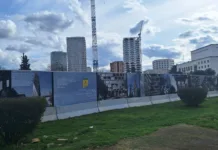



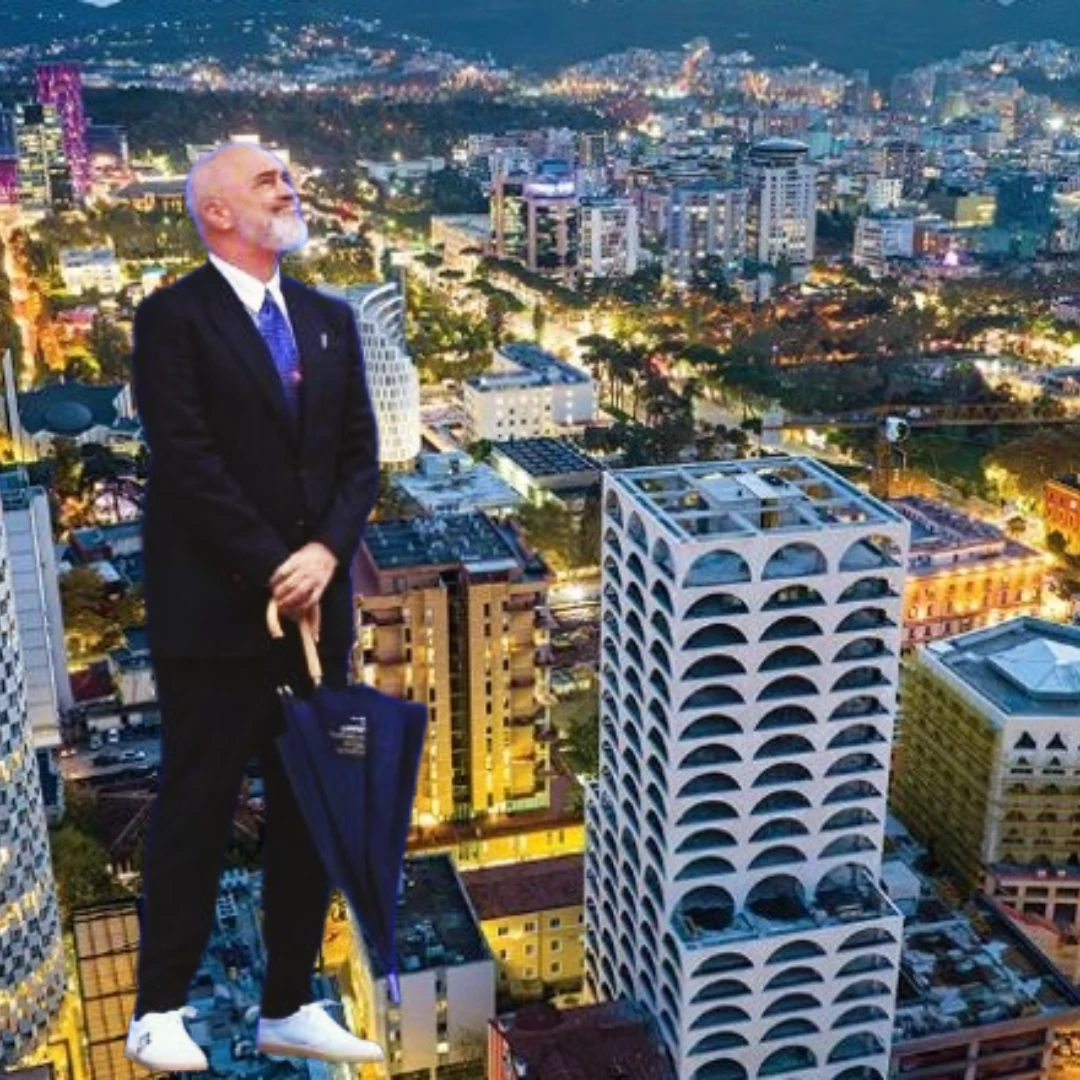
The trees in the center of Tirana are mostly low, some new, like the construction sites around Skanderbeg Square, where skyscrapers are being erected. The Clock Tower, once the tallest building in the city, looks out over the pedestrian area with the old mosque, the mosaic of the National Museum, but also the blue tower of a hotel and, next to it, another 85 meters high under construction, is the “Skanderbeg” building, designed by the Dutch studio MVRDV. It is a palace-sculpture, shaped like a head. “It represents the national hero who gave the square its name,” a guide explains to a group of tourists, “but what we see is the face of the prime minister, Edi Rama.”
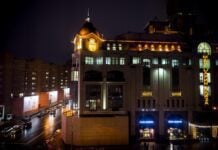
The construction site area is large. Above the barriers are drawings of the Tirana of the future that develops vertically, as theorized by architect Stefano Boeri in the regulatory plan “Tirana 2030”. A few steps further, another construction site: “Eves of Tirana”, 31 floors along 130 meters, Danish studio. The tower rises behind the Chamber of Commerce building.
The project includes a hotel, swimming pool, terrace, shops and a casino. There have been problems with undeclared volumes. Rama has expropriated them, claiming them as part of the state’s return of every abusive square meter. Starting with those above the center.
“Until 2018,” says Alba Kepi, a correspondent for Albanian media, “the central square could not be touched due to its historical value. Later, the protected space was redesigned by the Government and skyscrapers were built around it.”
Today, one square meter of them can be worth up to 5 thousand euros, prices affordable only for companies or luxury hotels.
“I don’t know anyone who lives there,” says a shopkeeper from the center, “ordinary people live in the old mansions or on the river side. They look empty.”
Ola Xama, an economic journalist, reported last year that in 2023, at least 51,129 out of 292,000 apartments with a contract for the national energy service had not consumed energy. Since 2018, the number of uninhabited apartments had tripled. But Rama has always considered this data to be untrue.
“These large buildings have little in common with the city’s historical identity, but also with the average salary of 600 euros for Albanians,” says Kepi. The construction sector drives the country’s economic growth, with over 3 billion in investments in the last two years.
“In Tirana alone, in the last 7 years, about 12 million m² of construction has been authorized, a significant part in the center,” explains urban planner Gentian Kaprata. More than 100 construction sites. The Prime Minister is at the head of the National Council of Territory, responsible for strategic projects and buildings over 6 floors. He appreciates the architects, the new buildings are signed by world-famous studios: Italian, Dutch, from northern Europe.
“Builders, on the other hand, are mainly Albanians,” explains Doriana Musaj from Polis University. Hotels benefit from fiscal incentives and local architects work in partnership with ‘archistars.’” But, always and everywhere, big investments bring big risks.
In its 2022 report, the General Directorate for the Prevention of Money Laundering mentions the real estate sector among the main tools. While the TAIF report (2024) cites as an example the involvement of a public official and a criminal entity in the purchase of real estate.
The business is actually attractive: “Construction and labor cost up to 800 euros per m², while the sale value can quadruple due to the privileged position.” And what about the estimates that say only a third of the capital comes from the banking sector?
“The Anti-Money Laundering Agency in Albania,” says Rama, “recognizes investors, banks, international hotel brands and clients: all in the light of day as buyers of space.”
For the prime minister, in fact, “there are clichés and accusations that touch on the criminal sphere (not based on facts), that resurface whenever there is talk about the historical change of Tirana or Albania,” and “when the discussion returns to the great members of the ‘Albanian ArchArmy.’” Neither the transformation of Tirana or Albania, he says, “nor the architects who contribute to it, can be treated starting from vague formulas and without evidence.”
The information is not so straightforward. “There is, for example, the phenomenon of leasing sales,” Kaprata explains. A builder pays suppliers and subcontractors with built-up area in exchange for work. In government records, this stock is considered sold, but in reality it is not.” “One apartment is occupied, while the other 19 are empty,” he explains.
“And Milan is a bad model,” says Alba Kepi, who adds: “If in Milan the urban space reflects its economic and financial heart, the same cannot be said for Tirana, where the population is shrinking and impoverished. Not even tourism can justify this residential bubble and the erasure of our history.”
Who is benefiting from the Rama-Boeri model?

Urban planning in Tirana is not just about the aesthetics and cultural heritage of the city, but it is deeper: it is about what I call here a ‘regime’ that is economically maintained by talking about the construction industry.
Fatos Lubonja is an Albanian writer and intellectual, known for his past as a dissident and for his commitment to denouncing abuses of power. He spent 17 years in prison under the regime of Enver Hoxha, from 1974 to 1991, for his opposition to the regime.
Fatos, is this a new superpower?
No, it has always existed, but now it has become stronger. We can say that the beginning of this economic, political and social system, since 1997, was of the “Berlusconian” type: the young Albanian rich, I would say enriched oligarchs, invested in construction and in the media with which they blackmailed or favored politicians to obtain building permits.
Their economic resources at that time came from immigrants who wanted to have a house in Tirana. Their interest was to build where prices were higher. Meanwhile, Albanian industry was disappearing, but no one denounced it.
Then what happened?
The need for housing increased, reaching its peak in 2005. It was always managed with the same dynamics and, once that need was exhausted, other types of speculation and clientelism spread, for example in the field of hydroelectric power plants. Then there was an acceleration and construction returned. However, in 2015, Mayor Veliaj, in his electoral campaign, had promised a total ban on construction in Tirana and that the center would not be affected.
Why was this promise betrayed?
For several reasons, in my opinion: the country no longer had economic resources, Edi Rama, first mayor, then prime minister, was ambitious and imagined the city as an extension of himself, and finally got used to this kind of concrete power. In 2023, according to some economists, almost 90% of the taxes paid in the Municipality of Tirana came from the construction sector, real estate and the entire related chain. It was a gold mine, but those oligarchs, although enriched, did not have all that money.
And who had them?
Albanian mafia, drug trafficking, dirty money. In some intercepts of Gratteri’s investigations, for example, the ‘Ndrangheta speaks of Albania as the Calabria of the 1960s for the ease of construction. This is how you get into the investment machinery and also become an intermediary between crime and the governance of the territory. 10-story hotels that could not fill the rooms are turned into 40-50-story towers. Money is laundered, locals are given a little work, politicians get their share, the administration collects taxes and everyone is happy. In Doha, they say that oil is taken from the ground and raised to the sky, in skyscrapers. But what is Albania’s oil?
Why then do we rely on the big names in architecture?
There is a need for a beautiful dress to cover and show the rush towards construction, for an authority, better if it is Western, to justify the “river” of permits and investments. In the Tirana 2030 plan, Boeri introduces the idea of ”vertical development”, of density and to develop and preserve an “orbital forest” with two million trees, skyscrapers are erected in the center, destroying without hesitation the artistic and cultural heritage, but also the quality of life of citizens.
Note: This article was published in the renowned Italian newspaper “Il Fatto Quotidiano”

RRKOKSH (Rrjeti për Raportimin e Krimit të Organizuar dhe Korrupsionit në Shqipëri), organizata juaj kryesore mediatike investigative e angazhuar për të hedhur dritë mbi krimin e organizuar dhe korrupsionin në të gjithë Shqipërinë. Nëpërmjet platformës sonë online në shteg.org, ne ofrojmë një gazetari të plotë dhe me ndikim që synon jo vetëm të informojë, por edhe të nxisë ndryshimet shoqërore.